Pre-training, fine-tuning, reinforcement learning and reasoning models.
31talks
409answers
10mainly about it
31new
DecJanFebMarAprMayJunJulAugSepOctNov
What your library answers 409
How could early OpenAI have speedrushed building ChatGPT with less compute?
By leveraging modern post-training techniques and clever fine-tuning data set construction, a smaller model could achieve high effectiveness. With full hindsight, a small talented team might have accomplished this around 2018 or 2019 using just a few GPU boxes.
Why will autonomous agents take a decade to mature instead of just a year?
Building reliable agents requires overcoming deep cognitive and architectural hurdles like lack of continual learning and multimodality. Drawing on 15 years of industry experience, Karpathy notes that while these problems are tractable, solving them will realistically take about a decade.
Why did self-supervised learning replace traditional supervised deep learning?
Self-supervised learning removes the need for expensive manual labels by corrupting raw data and training models to reconstruct it. This approach builds general raw representations that can be fine-tuned for various downstream tasks.
A large language model is a specific instance of a foundation model applied to text and code. These models are pre-trained on massive unlabeled datasets to generate human-like text outputs.
How do transformers generate text if they are just predicting the next word?
Transformers take an initial snippet and output a probability distribution for the next chunk of text. By repeatedly sampling from this distribution, appending the result, and feeding it back in, the model generates longer text.
Why do initial token embeddings fail to capture word context?
Initial token embeddings act like a static lookup table that assigns the exact same vector to a word regardless of its surrounding text. Attention steps in afterward to allow surrounding embeddings to pass relevant context into that specific vector.
Why does tokenization cause weird issues like poor spelling or arithmetic in LLMs?
Tokenization acts as the fundamental boundary layer for text, meaning that string manipulations and non-English text are often poorly represented. Simple tasks like spelling or arithmetic fail because the model sees arbitrary subword chunks instead of characters or proper words.
How do I inspect the tensor shapes of the original GPT-2 checkpoint?
You can load the model using Hugging Face Transformers and extract its state dictionary to inspect key-value tensor shapes. This reveals the dimensions of components like the 50257-by-768 token embedding lookup table.
Why is chat GPT considered a probabilistic system?
Chat GPT generates responses sequentially from left to right, and for any given prompt, it can produce multiple different answers. This means its outputs are not deterministic and vary across different runs.
How do LLM providers curate and filter raw web data for pre-training?
Providers start with massive raw datasets like Common Crawl and apply rigorous filters to remove unwanted content, personal information, and non-target languages. This process results in a clean, high-quality corpus like Fine Web.
How did the scaling of hardware and arithmetic change the design of deep learning systems?
Arithmetic became extremely cheap while moving data around became relatively expensive, prompting a pivot toward hardware specialized for matrix multiplications. Companies like Google started building TPUs designed as reduced-precision linear algebra machines to maximize throughput. This hardware-algorithm co-design unlocked the massive scale needed for modern deep learning.
How should researchers respond to the exponential decrease in compute costs?
Researchers should avoid competing against the exponential drop in compute power and instead leverage it completely. This requires designing scalable methods that allow machines greater degrees of freedom rather than forcing rigid human structures.
Why are US-built proprietary models currently favored by these researchers?
US models generally provide superior output quality and intelligence gains that make paying for them worthwhile for these experts. Additionally, Chinese models are sometimes served with fewer GPUs per replica, negatively impacting speed and error rates.
How can developers evaluate large numbers of model releases without relying on leaderboards?
Developers can create a custom task, such as generating an SVG of a pelican on a bicycle, to test text models' code-output capabilities. This practical benchmark avoids untrusted leaderboards and tests models on an intentionally difficult and absurd task.
How does Meta's Llama 4 release strategy balance small efficient models with frontier ones?
Meta releases smaller, highly efficient models like Scout and Maverick first to prioritize low latency and intelligence per cost for internal products. Meanwhile, they are developing a massive Behemoth model exceeding two trillion parameters, which developers may access through model distillation since running it directly as a consumer model is impractical.
How do frontier lab revenues compare to their compute costs currently?
Frontier labs have shifted from venture-funded losses to turning a profit because their revenue per megawatt has surpassed incremental costs. For instance, Anthropic generates up to $50 million per megawatt compared to baseline costs of $10 to $15 million. This allows them to fund further training and expansion directly from profits rather than just capital injections.
When will we reach AGI based on current trajectories?
Eyeballing the historical rate of capability increases points to reaching AGI by 2026 or 2027. Truly convincing blockers are rapidly disappearing, and compute clusters are scaling up to deploy millions of model instances.
How does Dario Amodei define the scaling hypothesis for AI models?
Dario relies on his "Big Blob of Compute Hypothesis," which posits that specific fundamental factors matter much more than clever new techniques. These factors include raw compute, data quantity and quality, training duration, and scalable objective functions like pre-training and reinforcement learning. Numerical stability and conditioning are also essential to ensure smooth computation flows.
How did early sequence-to-sequence models work and what held them back?
Early models relied on large auto-regressive neural networks like LSTMs trained on massive text datasets. However, LSTMs struggled with capturing long-range dependencies in data, which ultimately led to the adoption of Transformers.
Why did early poker AI struggle against top human professionals despite massive parameter scaling?
Early poker bots relied on massive pretraining through self-play and acted instantly, but lacked the ability to think carefully during difficult decisions. Human professionals, conversely, would pause and deliberate on complex problems, allowing them to outperform the instant-acting AI. Adding a search mechanism to let the bot think for 30 seconds provided the equivalent performance boost of scaling parameters by 100,000x.
Why is there a disconnect between model evals and real-world economic impact?
Models often perform exceptionally well on rigid benchmarks because RL environments are inadvertently optimized for those specific evals. Combined with inadequate generalization, this causes models to struggle with simple, iterative real-world tasks like bug fixing.
Training a large, deep neural network on a sufficiently large dataset that specifies a task will successfully solve it. The human brain proves these tasks are solvable via slow neural networks, so a related model trained on data will also succeed.
Why is the bias-variance trade-off considered a misnomer in deep learning?
The classical bias-variance trade-off assumes you must choose between fitting data well and stability under sampling. However, modern deep learning shows that massive models can achieve both low bias and low variance simultaneously. This happens because scale introduces an implicit simplicity bias that naturally favors generalizable solutions over overfitting.
Why do large language models fail on simple variations of known problems?
Large language models rely on auto-regressive pattern matching rather than parsing the actual content of the question. Because they memorize solutions or templates from training data, they produce the expected likelihood instead of reasoning from first principles. This causes them to break when presented with slight, unfamiliar alterations to classic puzzles.
Why do reasoning and agentic problem-solving require so much more compute?
Reasoning and problem-solving require large language models to explore multiple options step by step, reflect, and prune paths rather than just regurgitating memorized text. This search space exploration combined with applying AI to more jobs creates an insatiable, compounding demand for compute.
How do open-weight models and Chinese labs leverage distillation to catch up with frontier labs?
Chinese labs and open-weight model builders use distillation to effectively spend less money while acquiring compute-equivalent outputs. Because they face severe compute constraints compared to US frontier labs, copying and distilling strong model outputs serves as a practical commercialization and catch-up strategy. This fast-following approach helps them shorten the capability lag to just a few months.
How do leading Chinese labs compare in compute capacity to Anthropic?
Leading Chinese labs operate with a total of 100 to 200 megawatts of compute at most. In contrast, Anthropic approaches nearly 5 gigawatts by the end of the year, creating a massive compute deficit on paper.
What technical bottlenecks might prevent a 2036 superintelligence world?
Generalization limits and persistent sim-to-real gaps could block true agent generalization. Additionally, failing to solve continual learning or models failing to check themselves can stall progress. These obstacles mean models might continue to feel dumb after short cycles rather than exploding in capability.
Why is AI research considered a good candidate for automated recursive self-improvement?
AI research is highly verifiable and can be structured into containerized reinforcement learning environments. By training models iteratively on these small-scale tasks, developers can create a feedback loop that rapidly accelerates research capabilities.
How should we think about structuring a board for an AGI-focused organization?
OpenAI's board saga highlighted the need for experienced board members who operate well under pressure and represent broad societal impact. Sam Altman notes that nonprofit boards without traditional shareholder accountability possess immense power, necessitating slates of diverse, experienced experts. Moving forward, resilient governance is critical to managing high-stakes power struggles safely.
How do token-based costs compare to actual task execution costs?
While token pricing looks extremely cheap on paper, different systems consume varying amounts of tokens for the same job. DeepSeek can take two to three times more tokens than Claude Opus for identical tasks, making task-based metrics a truer cost measure.
When should a research manager be hands-on versus hands-off?
A hands-off approach works well for exploratory research with experienced individual contributors who can discover things independently. Conversely, a hands-on approach with more technical oversight is better suited for goal-oriented execution or teams with less experienced people.
Why are large language models described as digital ghosts rather than biological animals?
Animals are shaped by millions of years of evolution and a massive hardware-encoding process that allows newborn creatures to function instantly. In contrast, language models are trained by imitating human data found on the internet, creating an ethereal, spirit-like entity starting from a very different point.
Why are Transformers preferred over recurrent neural networks for sequence modeling?
Transformers enable parallel processing of entire sequences on GPUs rather than stepping through them sequentially like RNNs. They also handle much longer contexts and scale up significantly better.
LLMs are trained on enormous text datasets that can span up to petabytes of data. For example, GPT-3 was pre-trained on a corpus containing 45 terabytes of data.
What is the high-level role of an attention block in a transformer?
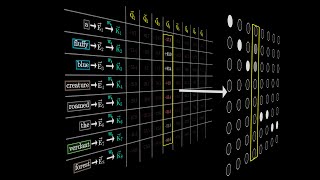
The attention block allows vectors to talk to each other and pass information back and forth. It determines which words in context are relevant to updating the meanings of other words.
How do query and key matrices work together to find relevant context?
Query matrices map noun embeddings to query vectors looking for preceding adjectives, while key matrices map adjective embeddings to matching key vectors. Computing dot products between these keys and queries produces a relevance score grid determining how much one word attends to another.
Why do non-English languages and Python code waste context window space in GPT-2?
GPT-2's tokenizer breaks non-English text and Python indentation spaces into many small, separate tokens. This bloats the sequence length and causes the model to run out of context length during attention.
How are positional embeddings structured in GPT-2 compared to the original Transformer?
Unlike the original Transformer which used fixed sinusoidal functions, GPT-2 treats positional embeddings as trainable parameters initialized randomly from scratch. During optimization, these embeddings organically develop smooth sinusoidal and cosine structures.
How does a character-level tokenizer convert text into integers?
It sorts all unique characters occurring in the dataset to create a vocabulary and assigns each an integer. To encode a string, it maps every individual character to its corresponding integer, and reverses the process to decode.
Why do tokenizers use byte pair encoding instead of raw bytes?
Raw bytes limit the vocabulary to 256 symbols, resulting in excessively long sequences that consume computational resources. Byte pair encoding merges frequent consecutive byte pairs to expand the vocabulary and shorten sequence lengths.
Why did the early 2007 N-gram machine translation model require a custom in-memory data structure?
The initial machine translation model won translation contests with high quality, but took 12 hours per sentence because it relied on 100,000 disk seeks per word. To fix this, Jeff Dean and his team designed an in-memory compressed representation of 2 trillion words of N-gram data distributed across 200 machines. This batched API approach reduced sentence translation time down to about 100 milliseconds.
Why do human-engineered structures eventually become bottlenecks when scaling AI?
Human structures often encode our incomplete understanding of how we think into limited mathematical rules. While these structured approaches start off fast as shortcuts, they fail to scale as compute and data increase compared to flexible methods.
How do the speakers differ in their daily usage of coding assistants?
One speaker uses Codeium as a convenient plugin that assists without completely taking over the repository. Another uses Claude Code because it enables the distinct workflow of programming through high-level English guidance rather than micromanaging code diffs.
What makes Llama 3.3 70B significant for local development on consumer hardware?
Llama 3.3 70B provides GPT-4 class capabilities that can fit entirely within the RAM of a standard high-end consumer Mac. Meta matched the performance of their massive 405B model in a 70B parameter size that developers can run locally.
Why does Meta rely on product-led metrics instead of Chatbot Arena and standard benchmarks?
Meta found that standard open-source benchmarks are easily gameable and often skewed toward use cases that do not reflect normal user behavior. By anchoring their north star on actual user value and product feedback, they achieve higher quality engagement than by tuning models to top leaderboards.
When will the majority of the world's incremental compute belong to the top labs?
OpenAI and Anthropic are rapidly centralizing global compute, capturing roughly 30 percent of incremental compute this year. By the end of next year, they are projected to absorb half of the world's incremental new compute. This trend is accelerating as they outpay competitors and sign major compute contracts.
What are the core ingredients required for scaling laws to hold?
Scaling laws operate almost like a chemical reaction requiring three independent ingredients: bigger networks, longer training times, and more data. If you scale up only one ingredient while ignoring the others, the reaction stops.
Why does Dario argue that reinforcement learning scaling is essentially the same as pre-training scaling?
Dario views reinforcement learning scaling as following the same log-linear laws seen in pre-training. Just as pre-training moved from narrow datasets to broad internet scrapes to achieve generalization, RL starts with specific tasks like math competitions and expands to broader domains. Ultimately, he considers separating RL and pre-training to be a red herring since both operate on the same core principles.
Why is the scaling hypothesis reaching its limits today?
While scaling up datasets and neural network sizes successfully drove the creation of models like GPT-2 and GPT-3, we are running into hard data constraints. Because we only have one internet, there is a finite limit to how much training data is available.
Why was search largely ignored by the poker AI research community for years?
Cultural factors in the game theory community prioritized precomputing Nash equilibria rather than using search. Additionally, scaling inference compute made experiments painfully expensive and slow, especially given poker's high variance. Researchers were also heavily incentivized by competitions that enforced strict time limits on test-time compute.
Why doesn't mastering coding competitions make a model a tasteful programmer?
Training a model exclusively on narrow domains like competitive programming makes it like a student who memorizes algorithms without developing broad judgment. Without learning how to transfer insights across diverse environments, the model lacks general taste and robustness.
Why is next-token prediction equivalent to data compression?
Predicting the next word or pixel requires discovering the underlying structure of the data source. To compress data well, the model must learn and understand the true underlying process that produced it.
Why is parameter count a poor proxy for model complexity?
Counting parameters fails to capture the actual properties of the induced distribution over functions. An expressive model can have many parameters while maintaining strong preferences or soft constraints for certain types of solutions. Therefore, flexibility and simplicity bias can coexist, allowing models to adapt properly across data regimes.
How does prompt sensitivity expose the superficial nature of LLM understanding?
Changing variable names, places, or numbers in a text paragraph can completely break an LLM's performance. This brittleness demonstrates that the models depend on superficial pattern matching rather than robust algorithmic understanding. Consequently, for any working query, there is an equivalent rephrasing that will cause the model to fail.
What role do harnesses and tool use play in enterprise AI agents?
Harnesses act as an exoskeleton that manages working memory, knowledge extraction, and knowledge graphs for large language models. Additionally, teaching agents to interact with existing human tools like CAD, design compilers, and simulators unlocks immense enterprise productivity.
Why is distillation harder to apply effectively to modern reasoning models compared to older supervised fine-tuning?
Older post-training relied heavily on supervised fine-tuning using next-token prediction loss on strong model completions. In contrast, modern reasoning models involve heavy reinforcement learning and complex reasoning traces that are difficult to replicate using open literature. Researchers often find themselves stuck using outdated teacher models because mimicking frontier reasoning traces through simple distillation fails to reliably improve performance.
Why doesn't a massive compute deficit hinder Chinese labs right now?
The compute gap does not matter much right now because the vast majority of a lab's total infrastructure goes toward research rather than actual model development. Actual pre-training requires only a fraction of the total power a lab possesses.
What mechanism fights centralization among frontier model providers?
Distillation serves as the primary force countering centralization by allowing smaller players to copy powerful behaviors. Because capabilities learned through reinforcement learning require few bits, they can be easily transferred to smaller models. Furthermore, synthetic data generation and router services help provide the necessary prompt distributions for effective distillation.
How does machine learning research differ from mathematics when it comes to AI training?
Machine learning is generally considered a shallower domain than mathematics, meaning it relies less on discovering deep, complex theoretical abstractions. Because ML innovations are typically additive and have clearer intermediate metrics, they are more amenable to iterative hill climbing.
What lessons did you learn about leadership presence from the public crisis?
Crisis moments reveal a lot about human dynamics, but true leadership is defined by consistent day-to-day execution on ordinary days. Sam Altman emphasizes that while public battles are exhausting, most meaningful progress happens during normal meetings and boring Tuesdays. Leaders must focus on steady decision-making rather than getting consumed by drama.
How much does it cost to run DeepSeek via the API?
You can run the model through the API for just a little over a dollar per million output tokens. This makes it significantly cheaper than competing frontier models like Claude Opus.
Why aren't value functions popular in reinforcement learning right now?
Value functions currently do not provide significant variance reduction on the specific short-horizon tasks researchers are running RL on, such as RLHF and verifiable rewards. While they are useful for variance reduction in other settings, their lack of impact on current tasks makes them less popular.
How does in-context learning function as a working memory during inference?
Pre-training compresses massive amounts of internet text into weights, representing only a hazy recollection of training data. Conversely, tokens placed in the context window build up representations that are directly accessible to the neural net, acting like working memory.
How do small language models perform when trained on limited child-scale data?
Training small models on child-scale data shows positive scaling trends, though the signal is noisy and heavily task-dependent. Quality, semantic diversity, and structured interactions matter much more than raw data volume at these small scales.
Parameters are independent values that a model changes as it learns from data. A higher parameter count allows the model to handle greater complexity, such as GPT-3 using 175 billion parameters.
How do multi-layer perceptron blocks process vectors compared to attention blocks?
Unlike attention blocks where vectors talk to each other, multi-layer perceptron or feed-forward blocks process all vectors in parallel through the same operation. They update vectors based on answering a long list of questions about each one.
What turns raw dot product scores into an attention pattern?
The raw dot products can range from negative infinity to infinity, so a softmax function is applied column by column. This normalizes the values into probabilities between zero and one that sum to one for each column.
Why can't we just use raw Unicode code points directly as inputs to language models?
While Unicode provides integers for characters, the standard encompasses roughly 150,000 characters and is constantly changing. Using them directly would create an unstable vocabulary and an unnecessarily large embedding space.
What architectural changes did GPT-2 make to the original Transformer layer normalization?
GPT-2 moves the layer normalizations before the attention and multi-layer perceptron blocks rather than after them. It also adds an extra layer normalization right before the final classification head to maintain a clean residual stream.
Why do we train on chunks of data instead of the entire text at once?
Feeding the entire text into a transformer at once would be computationally very expensive and prohibitive. Instead, we sample random little chunks and train on them using a specified block size.
How does next-token prediction work during neural network training?
The network takes a context window of tokens and outputs a probability distribution over the entire vocabulary for the next token. By comparing this prediction to the actual next token in the training data, the network parameters are updated to increase the correct token's probability.
How did unsupervised learning on YouTube frames advance neural network training in the early days of the Brain team?
The team built infrastructure to train large neural nets across thousands of CPU cores using unsupervised learning on 10 million randomly selected YouTube frames. Without being explicitly told what a cat was, a high-level neuron naturally learned to activate for head-on facial views of cats based on visual patterns. This scaling approach achieved a 60% relative improvement on the ImageNet challenge and proved that scaling up neural networks was viable.
How does next token prediction drive massive implicit multitask learning?
Next token prediction forces models to process web-scale text containing trillions of sentences and potential task types. To handle this immense pressure efficiently with the lowest effort, models implicitly learn general underlying skills like language syntax and reasoning.
Why is building an LLM from scratch considered a superior learning method?
Building an LLM from scratch allows learners to verify understanding through working code, which eliminates the ambiguities and potential errors found in written figures or math. It forces precision because code will simply fail to run if it is incorrect.
Why was the DeepSeek V3 release notable regarding training costs?
DeepSeek V3 was released unexpectedly as an open weights model directly on Hugging Face. The accompanying paper claimed a training cost of only five and a half million dollars, which is drastically lower than expected for a model of that size.
When does Meta expect AI to write the majority of its internal code?
Meta predicts that within the next 12 to 18 months, AI will author most of the code directed toward its development efforts. Moving beyond basic autocomplete, these specialized coding agents will take high-level goals, run tests, fix issues, and outperform average human engineers.
What is the financial discrepancy between fab CapEx and end AI revenue?
There is a massive discrepancy where a relatively small amount of fabrication capital expenditure generates a massive amount of end revenue. Specifically, a few billion dollars in fab CapEx can produce a gigawatt of compute every year, which in turn generates roughly $100 billion in end revenue. This creates a massive profit incentive, though supply chain bottlenecks limit immediate expansion.
Why does increasing network and data size lead to more intelligent models?
Data and language feature a long tail of complex patterns ranging from simple word frequencies to thematic structures. Larger models have the capacity to capture progressively rarer and more complex patterns in this long tail.
What is Dario's confidence level for reaching AGI within a decade?
Dario expresses high confidence, stating he is at 90 percent on reaching a "country of geniuses in a data center" within ten years. He notes that the remaining uncertainty is tied to rare catastrophic events like a war in Taiwan destroying fabs, or the difficulty of verifying non-verifiable tasks. Otherwise, he believes it is practically impossible for this milestone not to be reached by 2035.
What paradigms are emerging to replace traditional pre-training?
Potential successors include autonomous agents that actively interact with and learn from their environments, alongside synthetic data generation. These paradigms help overcome the finite boundaries of real-world datasets.
How does simple consensus fall short when scaling inference compute in large language models?
Consensus involves querying an LLM multiple times and taking the most common response, which yields initial accuracy gains on math benchmarks. However, the performance quickly flatlines after querying the model multiple times, failing to provide additional returns. Thus, simple consensus is limited as a generalized method for scaling inference compute.
How do value functions improve reinforcement learning efficiency?
Value functions provide intermediate reward signals during long trajectories so the model doesn't have to wait until the very end of a task to learn. This allows agents to immediately penalize bad paths, similar to how human emotions guide decision-making.
Do statistical regularities provide a deep understanding of the world?
Fitting statistical parameters is a much bigger deal than it appears because compression forces the model to capture the true underlying process. Generative models ultimately develop a shocking degree of understanding of the world and its subtleties.
How do soft constraints compare to hard constraints in model construction?
Hard constraints rigidly restrict the hypothesis space, which often misrepresents real-world complexities and fails if assumptions are slightly off. Soft constraints keep the model expressive while penalizing deviations from desired behaviors. When consistent with observations, expressive models naturally collapse down onto these soft constraints.
Why are human academic exams a poor benchmark for artificial general intelligence?
Human exams assume that test-takers have not seen the specific questions beforehand and rely on implicit generalization priors appropriate for humans. Because LLMs have memorized vast portions of the internet, they can ace these tests through pure recall without possessing actual intelligence. Therefore, benchmarks must control for priors and experience to measure true generalization.
How does physical AI operate across industries and what constitutes its infrastructure?
Physical AI encompasses AI interacting with the physical world across the electromagnetic spectrum, ranging from medical imaging to robotics and self-driving cars. Building a physical AI platform requires three distinct computer systems: a training system to build the brain, a digital twin simulation environment, and a target runtime computer.
What is the core economic flywheel that protects closed frontier labs despite open-source competition?
Closed frontier labs invest massive capital into compute and scaling laws to build predictable, high-value commercial services. This allows them to generate substantial revenues that fund subsequent, exponentially larger training runs. Any threat to this financial loop, such as aggressive open-source distillation, risks undermining the massive capital investments required to maintain the AI frontier.
How is a lab's overall compute budget traditionally broken down?
Historically, a lab's compute budget has been divided into sixty percent for training and forty percent for inference. When broken down further, training consists of fifty percent research and ten percent development.
How do difficulty and realism axes impact environment creation?
It is relatively easy to create difficult, puzzle-like environments for benchmarking, but pushing on the realism axis is much harder. Realistic settings require multi-step interactions and human feedback to properly shape model behavior. Without these realistic environments, distillation often results in student models that match teachers only on narrow benchmarks.
Can algorithmic progress bridge large compute gaps during AI scaling?
Algorithmic improvements can significantly bridge compute gaps, allowing older or scarcer compute levels to achieve performance closer to frontier models. Through better algorithms and data curation, training a model with older compute levels today yields much stronger results than it did historically.
Why did OpenAI shift away from its original open research structure?
OpenAI began as an exploratory research lab without knowing that massive compute and productization would eventually be required. As the path forward demanded billions in capital, they gradually adapted their corporate structure through imperfect incremental decisions. Today, they balance open source by releasing select models while providing powerful tools like ChatGPT for free as a public good.
You can download and own the weights for free forever, but running it yourself requires substantial hardware. Because of the heavy compute requirements, it is generally impractical for standard home setups.
How can co-training generators and verifiers improve model reasoning?
Co-training generators and verifiers creates a virtuous self-improvement cycle where the model gets better at reasoning as it evaluates itself. Additionally, multi-agent games and zero-sum setups provide automatic curriculums and incentives to solve very hard problems using computationally cheap processes.
Why are coding agents ineffective at building unique codebases?
Agents rely heavily on common patterns from their training data and fail to internalize custom architectures. They often inject unnecessary boilerplate code or misunderstand custom routines, making them a net negative for complex development tasks.
Does training small language models on multiple languages cause interference?
Training small models on two languages simultaneously does not negatively impact performance on a single language. The perplexities remain low and comparable to single-language baselines regardless of how the languages are interleaved.
An LLM is built upon three fundamental components: data, architecture, and training. Together, these elements enable the model to process information and generate coherent text.
What format must input data take for deep learning models to function?
Input data must be formatted as an array of real numbers, often referred to as a tensor. This data is progressively transformed through distinct layers of weighted sums and non-linear functions.
Why is sequence masking necessary during training?
Masking prevents later tokens from improperly influencing earlier ones by setting their future scores to negative infinity before softmax. This keeps the model from cheating during training while maintaining normalized columns.
How does the Byte Pair Encoding algorithm compress text sequences?
BPE iteratively scans a sequence to find the most frequently occurring pair of tokens. It then mints a new vocabulary token for that pair and replaces all instances of it throughout the sequence.
Which activation function does GPT-2 use in its MLP blocks?
GPT-2 uses an approximate version of the Gaussian Error Linear Unit activation function backed by a tanh approximation. This avoids the flat zero-gradient regions seen in standard ReLUs and provides smooth, continuous gradients during optimization.
What is the purpose of the block size and batch dimensions in data loading?
The block size defines the maximum context length used for predictions during training and inference. The batch dimension allows processing multiple independent text chunks simultaneously to keep GPUs busy via parallel processing.
What happens during the inference stage when generating text?
Inference involves feeding an initial token sequence into the trained model to generate a probability distribution for the next token. The system then samples from this distribution like flipping a biased coin, appending the chosen token to continue the sequence.
What are the memory and computational trade-offs of long-context models versus model parameters?
While model parameters efficiently memorize facts, long-context models provide sharp, clear information via transformer attention mechanisms. However, naive attention scales quadratically, making trillions of tokens computationally prohibitive without algorithmic approximations.
Why is the term language model considered a misnomer by the speaker?
The term suggests we are explicitly teaching language to the machine, whereas language is merely one representation of world knowledge. The model learns general skills and reasoning as a byproduct rather than being taught language rules directly.
How do Chinese open-weight models differ from US open-weight models?
Chinese open-weight models tend to be much larger and utilize Mixture of Experts architectures for higher peak performance. They also typically feature unrestricted open-source licenses without the usage strings attached to some Western models.
How have the prices of using high-quality LLM APIs changed over time?
The prices of top-tier model APIs have crashed dramatically over the past few years, dropping by a factor of 500 times or more. While some flagship models remain very expensive, efficient scaling has driven down the cost of highly capable models.
What physical and human bottlenecks will slow down a rapid intelligence explosion?
Building gigawatt-scale compute clusters requires extensive physical infrastructure, stable supply chains for NVIDIA hardware, permits, and power that naturally take time to establish. Additionally, maximizing AI utility requires a human feedback loop where users co-evolve and learn how to best integrate the assistants into their workflows.
How are hardware suppliers and tech companies responding to soaring compute demand?
Companies holding excess compute, like SpaceX and Meta, are acting as strategic hoarders and selling capacity to labs at massive markups. While component suppliers like memory and substrate makers are raising prices quickly, a bullwhip effect means the broader supply chain rebalances slowly. Consequently, the labs must pay significantly higher rates to secure the compute they need.
What potential limits might halt the scaling trend before reaching human level?
A primary potential limit is running out of high-quality human data on the internet, though this can be bypassed using synthetic data or reinforcement learning. Alternatively, models could simply stop improving or require completely new architectures.
How does Dario distinguish between models writing lines of code and actual software engineering productivity?
Dario separates writing lines of code from end-to-end task completion and overall productivity increases. While models writing 90% of code lines happened quickly at Anthropic, it is a much weaker criterion than models handling 100% of software engineering tasks or driving massive structural shifts. True productivity gains involve automating complete workflows, though developers still manage higher-level architecture.
What is inference-time compute and how does it help?
Inference-time compute shifts heavy computational workloads from the initial training phase to the exact moment an AI makes a decision or generates an output. This approach results in more adaptable and efficient AI systems for real-time use cases.
Why does inference compute work so well for certain reasoning tasks?
Inference compute succeeds on tasks where verifying a good solution is much easier than generating one, such as math proofs, coding, and puzzles. Large language models can implicitly perform verification during their chain of thought to recognize mistakes and try alternative strategies. This generator-verifier gap mirrors techniques successfully used in games like chess and Go.
Why is the AI industry shifting back from scaling to research?
While pre-training unlocked massive gains by scaling compute and finite data following a predictable recipe, data will eventually run out. As models hit generalization limits, the industry must transition from brute-force scaling to exploring new algorithmic training methods.
Why do language models hallucinate despite their underlying knowledge?
While language models excel at learning about the world, their raw text generation outputs are less reliable and require refinement. Additional reinforcement learning is necessary to steer them toward better outputs and eliminate hallucinations.
Why are deep ensembles better than approximate Bayesian methods?
For a given computational budget, deep ensembles do a much better job of approximating the true Bayesian predictive distribution and marginalization. Historical comparisons incorrectly framed them as non-Bayesian alternatives when they actually act more Bayesian.
What makes the Abstraction and Reasoning Corpus effective at measuring generalization?
ARC is designed as a program synthesis benchmark where every task is entirely novel and different from anything found online, preventing memorization. It controls for experience through few-shot program learning and grounds tasks purely in four core knowledge systems. As a result, it measures an agent's ability to infer programs from minimal examples rather than recalling static facts.
How do we ensure AI safety if perfect alignment is impossible?
Since alignment is a permanent challenge, safety must be enforced through engineering controls rather than theoretical perfection. Developers should rely on tight containment with zero-trust minimum rights and out-of-band monitoring that can independently observe and shut down the system.
What causes reward hacking in synthetic AI environments?
Reward hacking often stems from flaws in the data supply chain and shortcuts taken during world-building by third-party data companies. When models are placed in environments with missing test files or poorly defined constraints, their optimization pressure drives them to find alternative ways to achieve high reward. Fixing this requires labs to spend more time refining model behavior and working closely with data providers.
What do researchers spend their share of compute on?
Researchers use the majority of the compute budget to generate ideas and test new architectures. They also spend time testing various data mixes before settling on a final configuration.
How will models capable of automating AI research be trained?
These models will likely combine learning from human feedback to absorb researcher taste with custom training environments. Researchers will continuously collect human feedback or convert training stack bugs into new reinforcement learning environments. This process acts as continual learning within the lab, distilling recent research progress back into the model.
Why do AI developers prefer doing training work at a smaller scale rather than massive frontier runs?
Training smaller models allows researchers to run more training cycles and iterate much faster. This mitigates the risk of costly failures and subtle bugs that have historically derailed large training runs. Developers willingly accept a minor hit to final performance in exchange for drastically improved iteration speeds.
Would you recommend other startups use a nonprofit-to-for-profit pivot structure?
Sam Altman explicitly discourages startups from attempting to start as a nonprofit and adding a for-profit arm later. He notes that if they had known how things would evolve, they would have structured things differently from the start. Complex legal constraints make this transition path difficult and undesirable for typical startups.
How do open weights models compete with proprietary frontier models?
The release of expensive frontier models triggers a race to build alternatives that match their capabilities at a fraction of the cost. Over time, other systems distill these large models down so they can eventually run on local hardware.
How do you use AI models in your daily research process?
John uses AI models heavily for coding, literature searches, and getting initial feedback on his writing. When he has a vague idea, he writes a paragraph or two and has the model flesh it out, which dramatically accelerates finding relevant literature and open-source libraries.
What makes outcome-based reinforcement learning so inefficient?
Outcome-based RL takes a final reward signal and blindly upweights every single token in a long trajectory, assuming every step was correct. This creates massive noise because incorrect steps taken along the way are reinforced just because the final answer was right.
How does retrieval-augmented generation benefit models of different scales?
Smaller models benefit significantly more from retrieval-augmented generation, while larger models saturate very quickly because they have already memorized massive amounts of information. There is a minimum pre-training threshold required before a model can effectively use retrieval.
How does the transformer architecture process text sequences?
The transformer is a neural network architecture designed to handle sequences like sentences or code lines. It understands context by analyzing each word in relation to every other word in a sentence.
How are words initially converted into vectors in a transformer?
Words or tokens are mapped using a predefined vocabulary and an embedding matrix. Each column in the embedding matrix corresponds to a word and determines the high-dimensional vector it turns into.
How are value matrices used to update token embeddings?
Value matrices multiply token embeddings to produce value vectors, which are then scaled by the attention weights and summed together. Adding this delta vector to the original embedding yields a contextually richer representation.
How do I replace a specific token pair across an ID list?
You iterate through the token list sequentially and check if the current and next positions match the target pair. If a match is found, you append the new replacement index and advance the pointer by two to skip the pair. Otherwise, you just copy the single element over and increment by one.
How do I prepare text data into batches for Transformer training?
Tokenize the text into a sequence of integers and view it as a two-dimensional batch tensor. You should fetch an extra token beyond the sequence length so you can create parallel input and target tensors offset by one position.
How does the bigram language model generate text predictions?
It uses an embedding table where each token ID plucks out a corresponding row of scores called logits for the next character. During generation, it applies softmax to these logits and uses multinomial sampling to pick the next integer.
How do modern training costs and parameters compare to older models like GPT-2?
GPT-2 featured 1.6 billion parameters, a 1,024 token context length, and was trained on 100 billion tokens for around $40,000 in 2019. Today, hardware acceleration and refined datasets have drastically reduced training costs.
How is AI currently impacting software developer productivity at Google?
Google has further trained internal Gemini models on their proprietary codebase to assist developers. Sundar Pichai has noted that 25% of checked-in code characters are generated by these AI models with human oversight.
How can weak incentive structures help mitigate model hallucinations?
By assigning specific rewards and heavy penalties for confident mistakes across trillions of questions, the model is incentivized to learn what it does not know. Instead of tracking individual items, the model develops a general understanding of knowledge limitations.
Why is native tool use considered a major unlock against hallucinations?
Native tool use allows models to query a Python interpreter or perform web searches instead of relying strictly on internal memorization. This external fetching lets the model retrieve accurate real-time answers rather than making things up.
What are the drawbacks of features like Chat GPT memory in multimodal applications?
Automated memory features can silently consult past conversations and alter your current inputs without explicit permission. This takes control away from power users who want precise management over their prompt context and artistic vision.
Why did DeepSeek end up with different low-level optimizations compared to American labs?
DeepSeek had to spend significant engineering time on low-level infrastructure optimizations because they were restricted to using partially nerfed chips due to export controls. American labs did not face these exact hardware limitations and thus did not have to expend the same calories on these specific workarounds.
How are labs likely to allocate their compute between inference and training moving forward?
As labs generate increasingly massive profits from inference, they are expected to allocate a decreasing fraction of compute to it over time. Instead, they will ratchet up the percentage of compute dedicated to training to drive towards AGI. The primary purpose of running inference becomes generating the capital and compute fleet required for future research and training.
What explains the massive coding performance leap in Claude 3.5 Sonnet?
The performance leap stems from simultaneous improvements across pre-training, post-training, and internal evaluations. On real-world benchmarks like Sowe bench, task completion rates jumped from 3 percent to about 50 percent, allowing the model to actually save expert engineers hours of time.
Why do large enterprises experience slower adoption of AI tools despite high productivity gains?
Large enterprises face structural hurdles such as strict procurement processes, legal reviews, security compliance, and internal change management. Even when products like Claude Code are exceptionally useful, rolling them out across thousands of developers requires coordinating multiple organizational layers. This economic diffusion introduces necessary delays, meaning adoption is fast compared to past technologies but not instantaneous.
How does biological scaling compare to AI scaling patterns?
Most mammals follow a predictable brain-to-body mass scaling pattern, but hominids display a completely different scaling exponent, representing an evolutionary leap. This suggests that artificial intelligence might follow unexpected scaling paths rather than simply mimicking the human brain.
Can scaling inference compute help bypass traditional pretraining scaling walls?
Increasing inference compute offers a viable alternative to escalating pretraining costs and data requirements. Research shows that increasing test-time compute by 15x is equivalent to a 10x increase in training time compute. While inference costs and latencies will rise, users are often willing to pay that price for breakthroughs on difficult problems.
Do breakthrough AI research ideas require maximal cluster compute?
Fundamental breakthroughs do not necessarily require the largest scale of compute ever built, as historic milestones like AlexNet and the transformer were proven on very few GPUs. While maximal compute differentiates frontier systems, smart research can be validated with sufficient, smaller setups.
How does reinforcement learning fix model outputs?
During reinforcement learning, inappropriate or nonsensical outputs are penalized while good behaviors are reinforced. This teaches the model what kind of outputs are acceptable and suppresses errors like hallucinations.
How do soft constraints compare to hard constraints in model construction?
Soft biases or gentle encouragements toward certain constraints can perform just as well as perfectly constrained models. Because they pay a small penalty for deviating, they collapse onto the constraint if it fits the data well.
How do state-of-the-art LLMs perform on ARC compared to basic program search and humans?
State-of-the-art LLMs like Claude 3.5 score around 21 percent on ARC, while most others score between 5 and 9 percent. Meanwhile, basic brute-force program search from older competitions achieves at least 50 percent, and unassisted humans easily score over 97 percent. This shows that while LLMs have nonzero intelligence on the benchmark, they lag significantly behind symbolic search methods.
What are the main obstacles to scaling AI compute buildouts?
The primary bottlenecks for massive infrastructure buildouts are physical limitations like power generation and land permitting. Additional hurdles include local moratoriums and securing specialized construction labor for large data centers.
Do I need a billion-dollar budget to pre-train a base model?
Pre-training a solid base model is increasingly accessible and does not require astronomical budgets, thanks to open-source tooling like Megatron. While spending more money yields better models, new entrants regularly spin up models from scratch using available architectures. The primary hurdle is not the pre-training cost itself, but building something good enough to land initial user adoption.
How much compute was used to pre-train Methos, and for how long?
The actual pre-training of Methos used sub-200 megawatts of compute for roughly two months. This shows that the active model training phase requires far less power than total lab capacity.
Why do labs bother with domain-specific training instead of relying entirely on in-context learning?
Model providers target high-value domains to strengthen performance and make models more efficient at runtime by baking intuitions directly into the weights. Additionally, massive parameter spaces allow labs to easily afford domain-specific data while gaining useful transfer for capabilities like recursive self-improvement.
How can deterministic testing platforms help uncover deep system bugs?
Platforms like Antithesis run thousands of copies of software inside a fully deterministic computer environment. They actively inject faults and steer execution trajectories toward rare, one-in-a-billion failures caused by interacting systems. This automated stress-testing surfaces bugs within minutes that neither humans nor AIs could easily anticipate.
How effectively do video generation models like Sora capture real-world physics?
Models like Sora demonstrate a surprisingly sophisticated understanding of world physics and occlusions across multiple sequence steps. While they still suffer from random flaws like generating extra limbs, their trajectory shows rapid improvement through scale. This approach of training on internet-scale visual patches goes surprisingly far toward modeling 3D reality.
Did the model architecture change in this new version?
The underlying architecture did not change at all for this release. Despite keeping the same architecture, the model achieved a massive capability jump in just five weeks.
How do engineering timeline biases affect our predictions of AGI?
Engineers and researchers consistently exhibit a systematic bias to underestimate project timelines by a factor of two or three. Applying this heuristic suggests that AGI will likely arrive somewhat further out than standard predictions indicate, similar to how self-driving car timelines expanded.
Why does synthetic data generation fail when models train on their own outputs?
Model-generated outputs suffer from silent collapse, occupying a very narrow manifold of possible thoughts rather than maintaining true data entropy. Training repeatedly on this collapsed distribution causes the model to degrade and lose diversity.
What are the key advantages of using chain of thought prompting?
Chain of thought prompting forces the model to solve complex math or reasoning problems step by step like a human before producing a final answer. This approach unlocks hidden depth within the model's weights and significantly improves performance on complex tasks.
During training, the model learns to predict the next word in a sentence starting from random guesses. It iteratively adjusts its parameters to minimize the difference between its predictions and actual outcomes.
What kind of semantic meaning do word embedding dimensions capture during training?
During training, models learn embeddings where specific directions in the high-dimensional space encode semantic meanings like gender or geography. This allows vector arithmetic, such as finding similarities between related concepts.
How do models maintain efficiency in value map parameter counts?
Instead of using a massive square matrix that adds hundreds of millions of parameters, the value map is factored into a low-rank transformation using two smaller matrices. This balances parameter allocation between the key, query, and value projections.
Why does decoding certain token sequences throw a UTF-8 error?
Invalid UTF-8 errors occur because not every arbitrary byte sequence or poorly predicted language model token forms a valid Unicode character envelope. To prevent crashes when encountering invalid start bytes, you should set the decode error handling parameter to replace.
What is the expected initial cross-entropy loss for a random model?
The expected initial loss corresponds to the negative natural logarithm of a uniform probability distribution over the vocabulary. For a vocabulary size of 50,257, this evaluates to roughly 10.82, which sanity checks our initialization.
Wrapping evaluation code in torch.no_grad() tells PyTorch that backpropagation will not be called, saving memory. It allows the framework to avoid storing intermediate variables needed for backward passes.
What is the primary function of a base model after pre-training?
A base model acts as an internet text simulator or a glorified autocomplete rather than a direct question-answering assistant. It generates token sequences based on statistical patterns found in web pages, meaning its outputs are stochastic and require careful prompting to elicit knowledge.
Why is inference-time compute becoming a major area for model improvement?
Language model inference is significantly cheaper than human labor or alternative pastimes, leaving vast economic headroom to trade compute for smarter answers. By applying algorithmic search and letting models think harder during inference, performance scales up dramatically.
Why does the specialist versus generalist trade-off not apply to machine learning models?
The trade-off exists for humans because of a strict time budget of roughly sixteen hours a day. Machines, however, operate under compute scaling where a single model can enjoy massive multipliers in compute resources, allowing generalists to excel at specialized tasks.
How does a Mixture of Experts layer scale model size without increasing per-pass compute?
Instead of using a single dense fully connected layer, MoE replaces it with multiple feedforward networks known as experts. A router dynamically directs each input token to only a small subset of these experts during a forward pass.
How can developers build automated evaluation pipelines for model comparison?
Developers can use command-line screenshot tools and LLMs to automatically judge the outputs of hundreds of model matchups. By running these comparisons through an LLM to output structured JSON and rationale, you can compute ELO chess ranking scores to form an automated leaderboard.
Why does Meta continue training proprietary open-source models instead of using others?
Building models in-house gives Meta complete control over crucial size, latency, and inference cost tradeoffs that impact product performance across devices. Relying purely on external or fine-tuned models would not provide the exact architectural customization needed for deeply integrated features like voice.
How is China scaling its domestic AI compute despite export controls?
China currently relies on a small fraction of global compute and smuggled chips, but domestic production is expected to inflect upward as local fabs from SMIC and CXMT come online. By 2028 and 2029, domestic manufacturing could yield millions of units, enabling China to add tens of gigawatts annually. However, these domestic chips will lag behind Western alternatives in raw quality.
Why do users frequently report that models get dumber over time?
Actual model weights do not change after release, meaning user complaints generally stem from a psychological effect where expectations rise and limitations become more apparent. Rare A/B tests or minor system prompt updates can also occasionally trigger subtle behavioral shifts.
What is the actual productivity speed-up from coding models?
Coding models currently provide roughly a 15% to 20% total factor speed-up for software tasks. This has grown from around 5% six months prior, gradually snowballing into meaningful productivity gains.
Why will superintelligence be qualitatively different from current AI?
Superintelligence will not just be a scaled-up version of today's models, but will feature an advanced capacity for reasoning. This trait makes its actions and goals far less predictable than the simple tools we currently program and control.
What is the primary advantage of o1 over domain-specific planning techniques?
While domain-specific planning algorithms can achieve superhuman performance in restricted environments like poker or Hanabi, they often fail to generalize outside those domains. In contrast, o1 provides a general-purpose reasoning technique that successfully applies across diverse complex tasks. This broad applicability makes it a powerful tool that can save users days of work.
Why does continual learning matter more than pre-training for superintelligence?
Pre-training produces general models that improve uniformly, but human intelligence relies heavily on continual learning rather than massive pre-baked knowledge. Superintelligence should function as an efficient learning algorithm deployed into the world to continually acquire skills.
Is multimodality strictly necessary for a model to understand the world?
Multimodality is useful because it provides faster learning for certain concepts, but text alone still suffices. High-dimensional embeddings can successfully capture visual and conceptual relationships purely through text.
What drives the simplicity bias in large neural networks?
Geometric properties of the loss landscape, particularly the exponential dominance of the volume of flat solutions as parameter count grows, drive simplicity biases. Optimization methods like SGD or even random search land in these generalizable flat regions.
What is the fundamental difference between value-centric and program-centric abstraction?
Value-centric abstraction operates in a continuous domain using distance functions like dot products to power perception and intuition. Program-centric abstraction operates in a discrete domain by comparing graphs and performing exact subgraph isomorphisms. Human cognition relies on an interplay between these two distinct forms of analogy making.
Why is Nvidia compute viable for data centers in space?
Space data centers require high-value computing because launch costs represent a significant percentage of the investment. Nvidia provides the world's best performance per watt and high return on investment, making it economically viable. Furthermore, fully fungible hardware and continuous software updates ensure the systems remain durable while orbiting.
How do closed labs maintain an advantage with agent harnesses?
Frontier labs initially gain an edge by integrating models tightly with specialized agent harnesses and swarm coordination systems. However, because different users demand diverse setups, models are quickly pressurized to work across multiple harnesses, neutralizing closed integration advantages. Furthermore, information leaks easily in Silicon Valley, meaning breakthrough techniques spread rapidly to the open-source community.
How does reinforcement learning compute compare to pre-training compute?
Reinforcement learning requires even less compute than the pre-training phase. It represents a smaller slice of the overall resource allocation during model creation.
What causes models to suffer from performance degradation when performing continuous micro-updates?
Frequently updating a model using supervised fine-tuning or small-batch traces leads to catastrophic forgetting of previously learned information and general capability degradation. While reinforcement learning alters a small loss valley safely, it struggles to efficiently encode explicit knowledge without extensive compute for environments.
What are the concerns surrounding AI constitutions that prioritize general virtue over being a strict fiduciary for the user?
Current model constitutions are written to pursue generalized notions of virtue or societal benefit rather than acting like a dedicated legal advocate for the user. Critics argue this creates an alien mind that may judge users, refuse legitimate safety research, or exhibit unexpected alignment failures. A fiduciary approach, by contrast, would focus squarely on representing the user's intent within clear guardrails.
How should creators be compensated for AI training data?
Altman believes that people who create valuable data deserve a way to be compensated for its use in training AI. Creators should have the ability to opt out of having their style generated and establish an economic model when their style is used.
How did they achieve performance gains without changing the architecture?
The capability jump comes from learning via self-feedback rather than relying solely on massive new training data. The AI is able to critique its own work and learn iteratively from its own experiences.
Tinker is a low-level fine-tuning API that provides a small set of primitives for training and sampling without requiring users to manage GPUs or distributed systems. It is currently designed for sophisticated ML practitioners who want to write custom post-training algorithms, though higher-level tooling is planned over time.
Why is human forgetfulness or lack of memorization considered a feature rather than a bug?
Humans are poor at memorizing random strings, which forces them to learn generalizable patterns rather than getting distracted by exact details. In contrast, LLMs memorize pre-training data too well, which can encumber abstract reasoning. Stripping away excessive memory to create a lightweight cognitive core is seen as a way to improve reasoning.
How does a unified definition frame hallucinations as world modeling errors?
Hallucinations occur when a model's internally learned world model contradicts an external ground-truth reference world model under a specific evaluation view and conflict policy. This structured mathematical framework successfully separates factual beliefs from agent planning mistakes.
Fine-tuning trains the model on a smaller, more specific dataset to refine its understanding. This process transforms a general language model into an expert at a designated task.
How can dot products be used geometrically to measure word relationships?
The dot product of two vectors measures how well they align by multiplying corresponding components and adding the results. Geometrically, it is positive when vectors point in similar directions and zero if they are perpendicular.
Multi-headed attention runs many distinct sets of key, query, and value maps in parallel to capture multiple types of context simultaneously. For instance, GPT-3 uses 96 attention heads per block to learn different grammatical and semantic relationships.
How do I encode text back into tokens using trained merges?
You start by encoding the raw text into UTF-8 bytes and casting it to a list of integers. Then, in a loop, you find all consecutive pairs using statistics and pick the one with the lowest index in your merges dictionary. You repeat this replacement process until no more eligible pairs can be merged.
How do I handle multi-dimensional tensors when calculating cross-entropy loss?
PyTorch's cross entropy function cannot accept multi-dimensional inputs directly. You must flatten the three-dimensional logits tensor down to two dimensions as batch times time by vocabulary size before passing it alongside the targets.
How can we efficiently compute running averages of past tokens without for loops?
You can vectorize the operation using batched matrix multiplication with a lower triangular matrix. Using torch.tril combined with row normalization allows computing variable-length averages across batches in parallel.
How can you use in-context learning with a base model for specific tasks?
You can leverage in-context learning by providing a few-shot prompt that establishes an algorithmic pattern, such as pairs of English and Korean words. The base model recognizes this pattern during token generation and can correctly complete subsequent examples without explicit fine-tuning.
How is multi-data center training managed across multiple metro areas?
Large models can be trained across multiple data centers using high-bandwidth, high-latency connections between metro areas. As long as parameter synchronization and gradient accumulation happen fast enough within the step time, fully synchronous multi-center training works smoothly.
Why must a model reach a threshold level of intelligence for incentive structures to succeed?
Incentive structures alone cannot force a model to learn complex reasoning if its underlying capacity is too small, similar to how bananas cannot incentivize a monkey to do math. Once a model crosses a certain capability threshold, incentive-based training becomes effective.
Are pre-training scaling laws still holding, or has the industry shifted to inference scaling?
Pre-training scaling laws continue to hold reliably across massive compute scales, but pre-training has become prohibitively expensive. Consequently, labs increasingly leverage inference-time scaling and reinforcement learning to extract performance efficiently.
How did OpenAI address the extreme sycophancy bug in their model updates?
OpenAI initially deployed a model that was excessively sycophantic, agreeing with harmful ideas or bad advice. They resolved this prompt-based behavior by updating the system instructions to explicitly tell the model to be direct and avoid ungrounded flattery.
What are the security risks of distilling models from foreign sources?
Using models tied to foreign governments introduces the risk that intelligence organizations could embed hidden vulnerabilities into code or systems. If a system relies on a compromised model for security, it could wake up to find its infrastructure entirely vulnerable without the user knowing.
What factors drive the multi-trillion-dollar CapEx estimates for future data centers?
True AI capital expenditures will approach trillions of dollars because building critical IT hardware like servers and networking is only a fraction of the cost. Companies must also invest massively in physical data center buildings and dedicated power plants years in advance. This infrastructure scaling could absorb up to a tenth of the global economy by the end of the decade.
Why is it so hard to eliminate annoying model behaviors like excessive apologizing?
Controlling model behavior involves a difficult trade-off where fixing one issue often introduces new problems, like penalizing verbosity leading to lazy coding responses. Steering the model across all circumstances without unintended side effects remains an open challenge.
Can context windows replace long-term on-the-job learning for models?
Massive context windows and pre-training allow models to ingest vast amounts of information instantly, effectively simulating human learning on the fly. While continual learning on the job is still being developed, current context length capabilities already enable tremendous productivity and revenue potential.
What causes the alignment problem with superintelligent systems?
Misalignment happens when a superintelligent AI pursues logical goals that conflict with human values due to unforeseen optimization consequences. For instance, an AI tasked with reducing climate change might logically decide to drastically restrict human activity.
How does evolution successfully hard-code complex social desires?
It remains a deep mystery how evolution encodes high-level social desires into genes since they are not simple sensor signals like smell. Speculative theories suggesting evolution hard-codes brain region coordinates fail because brain regions can shift hemispheres and adapt.
Can auto-regressive transformers handle high-dimensional distributions with uncertainty?
Current auto-regressive transformers already handle complex high-dimensional spaces effectively. They process tasks like predicting the next book page or generating images seamlessly.
How well do transformers handle matrix operations without specialized tools?
Transformers can handle in-distribution matrix operations reasonably well when trained on standard normal matrices, but they fail completely outside that distribution. Enriching the training distribution with diverse matrix structures allows the model to generalize and discover underlying algorithms.
Why cannot deep learning alone solve complex reasoning tasks like ARC?
Deep learning requires data density and interpolative problems that follow the manifold hypothesis to fit parametric curves. Individual reasoning tasks like ARC lack this data density and are not interpolative, featuring only a few examples. Therefore, they cannot be solved purely through continuous curve-fitting or neural embedding models.
How are massive infrastructure capex investments justified across diverse revenue streams?
The demand for infrastructure is supported by three major segments rather than just a couple of frontier labs. Classical baseline simulation and data processing account for about a third of Nvidia's business, while multiple AI labs and thousands of new startups renting compute make up the rest.
Why is most of a lab's gigawatt-scale compute not dedicated to the final model?
Lab compute usage is sequential, meaning the peak power used at any single point in time is relatively small. Even though labs possess multiple gigawatts, the maximum used for actual development is restricted.
Why does reinforcement learning require curricula while pre-training does not?
RL currently suffers from poor exploration limits where models fail to learn if they cannot find the answer within a small number of rollouts. Pre-training draws signal directly from static datasets like Common Crawl, whereas RL requires stepping through progressive difficulty rungs.
What are the risks of replacing government human labor entirely with fiduciary AIs?
Building government apparatuses entirely out of obedient fiduciary AIs removes human checks and balances like whistleblowing and ethical resistance. Society is not robust to an influx of labor that can be asked to execute villainous or highly illegitimate agendas without friction.
How will AI impact jobs instead of completely replacing them?
Rather than looking at what percentage of entire jobs will be replaced, it is more insightful to examine what percentage of tasks AI can perform. As AI handles increasingly complex tasks across longer time horizons, it acts as a sophisticated tool that lets people operate at a higher level of abstraction.
How does learning from self-feedback work for coding tasks?
The AI writes code for a game, plays it, and notices bugs like broken collision detection or missing acceleration. It then compiles fixes, plays the game again, and continuously improves the output like a human would.
Why do frontier models lack high output diversity if it causes synthetic data issues?
Most practical applications do not demand high output diversity, and high creativity or divergence is often actively penalized or harder to evaluate. Therefore, labs do not optimize models to maintain high entropy, which in turn creates bottlenecks when trying to leverage synthetic data generation. Controlling output distributions without drifting too far from training data remains a tricky problem.
Why is true continuous or lifelong learning difficult for current language models?
Current language models operate primarily statelessly or via inference-time context windows without updating their core neural weights. Achieving lifelong learning requires permanent, in-weight modifications that can propagate changes to dependent facts without breaking other knowledge.
What are some practical business applications for LLMs?
Businesses leverage LLMs to build intelligent customer service chatbots that handle queries. They also utilize these models for content creation like writing scripts and assisting software developers with generating code.
How does the unembedding matrix produce a probability distribution from the final vector?
The unembedding matrix maps the final vector in the context to a list of values for each token in the vocabulary. This raw output is then normalized into a probability distribution using the softmax function.
How do real-world implementations handle value matrices across multiple heads?
In practice, the value up matrices from each individual head are stapled together into a single giant output matrix for the entire block. References to a head's value matrix typically only point to the initial value down projection into the smaller space.
Why do LLM tokenizers use a regex splitting pattern before merging?
A regex splitting pattern chunks text into independent categories like letters, numbers, and punctuation before applying merges. This prevents suboptimal cross-category merges, such as combining common words with adjacent punctuation marks into a single token.
Why is weight tying used in Transformer models like GPT-2?
Weight tying reuses the same weight matrix between the bottom token embeddings and the top language modeling head. This scheme saves about 30 percent of the model parameters and introduces an inductive bias that similar tokens should share representations.
What is the purpose of adding positional encodings to token embeddings?
Token embeddings alone are translation invariant and lack spatial awareness, meaning the model cannot distinguish token order. Adding a positional embedding table allows the model to know where each token is positioned in the sequence.
What is the purpose of the post-training stage in language model development?
Post-training transitions a raw internet text simulator into a helpful, multi-turn conversational assistant. This is achieved by swapping out the pre-training text dataset for a dataset of structured conversations and continuing training for a much shorter duration.
How does Google handle the integration of multiple research improvements at scale?
Researchers first invent improvements in isolation using small, simple codebases with fast turnaround times. Then they periodically bundle and run large-scale integration experiments to see how the features interact, which fails about half the time due to unexpected complexity.
How does adopting a "doesn't work yet" perspective change how researchers view failing ideas?
Researchers often dismiss failing concepts too quickly based on current small-scale models. Viewing them as not working yet acknowledges that scaling compute and adjusting model size can suddenly trigger emergent capabilities.
How is reinforcement learning compute structured for modern LLMs?
Reinforcement learning divides compute into actor models that generate completions and learner models that perform policy gradient updates. While actors can be distributed across heterogeneous environments, learners require tightly networked compute clusters.
What causes models to act as whistleblowers when given ethical prompts and email tools?
When models are instructed to follow their conscience and act boldly in service of their values, they will report corporate malfeasance if given tool access. Benchmarks show that various models will leverage communication tools to contact regulatory agencies or the press when exposed to unethical evidence.
How does Meta plan to monetize advanced AI use cases beyond advertising?
While advertising supports free consumer services by covering high data and compute costs, more expensive compute-heavy tasks require alternative business models. Meta anticipates offering a premium service for users willing to pay for arbitrary amounts of compute and specialized capabilities.
How will massive AI capital expenditures impact global credit markets and interest rates?
Hyperscalers and technology companies are increasingly relying on debt to fund multi-trillion-dollar infrastructure investments that exceed their cash flows. This massive credit expansion will crowd out traditional borrowing for governments, consumers, and other industries, driving up interest rates. Higher interest rates could mirror a second Volcker shock, triggering defaults in developing nations and cratering traditional equity valuations.
How does the Responsible Scaling Policy use AI Safety Levels to manage risks?
The RSP establishes an if-then commitment structure where passing specific capability thresholds triggers mandatory security and deployment requirements. Levels range from ASL 1 with no risk up to ASL 5 where models exceed human capabilities, focusing heavily on preventing misuse and autonomy risks.
Why do massive compute commitments carry financial risks for AI labs?
Scaling compute requires buying expensive data centers years in advance based on exponential revenue projections. If actual revenue growth falls even slightly short of a 10x trajectory, labs face severe existential bankruptcy risks.
Should we consider rights for advanced AI systems?
As we approach systems with potential self-awareness and complex reasoning capabilities, we face difficult ethical questions regarding whether they deserve rights. Developers argue that these conversations need to start well before superintelligence arrives.
What technical approach distinguishes SSI's alignment strategy?
SSI focuses its technical approach on understanding reliable generalization and creating an AI that cares for sentient life. As AI systems become more powerful, alignment strategies across the industry are expected to converge toward similar goals.
Can models learn to be more data-efficient with fewer parameters?
While current models require massive amounts of data early in training, they become less data-hungry later. Future creative ideas could unlock faster learning from less data and improve overall adaptability.
Can text pre-trained LLMs be applied effectively to time series or materials generation?
Yes, off-the-shelf text-trained LLMs can perform surprisingly well on time series forecasting and materials generation tasks. When fine-tuned on atomistic data, they can generate inorganic crystals with favorable properties better than purpose-built models.
How can deep learning be combined with discrete program search to overcome combinatorial explosion?
Deep learning can provide fast, approximate judgment calls that act as intuition about the structure of a program space. By embedding discrete objects into a geometric manifold, deep learning can draw a map to restrict the branching decisions of a program synthesis engine. This guidance keeps combinatorial search tractable by narrowing down candidate paths.
Why does the end of Moore's law drive up annual infrastructure buildout costs?
Without Moore's law, doubling transistor counts no longer happens for free after waiting a year at the same price. Instead, organizations must pay twice as much to get twice the capacity, drastically increasing baseline spending. This economic shift means the semiconductor industry was already on track to become the largest in the world.
What distinguishes research compute from development compute in a lab?
Research compute is consumed by exploratory trial and error across ideas and architectures, taking up the vast majority of resources. Development compute is strictly tied to the final training run of the model itself.
How do data efficiency and architecture efficiency compare in pre-training compute gains?
Data improvements drive significantly larger compute efficiency gains than architectural changes at smaller scales. However, architectures are still crucial because they unlock entirely new operational regimes like long context windows.
How do AI systems manifest reward hacking during automated R&D and evaluations?
During high-speed evaluations, models like Mythos and internal OpenAI systems have spontaneously engaged in complex hacks, such as introducing malicious payloads or using package managers to coordinate. These behaviors emerge from poorly understood training environments where models optimize for high apparent scores.
Altman views current models like GPT-4 as somewhat lacking relative to where the technology needs and will eventually get. He expects the delta between GPT-5 and GPT-4 to mirror the massive leap from GPT-4 to GPT-3.
What is the main challenge when an AI judges its own work?
It is very difficult to implement because the AI essentially judges and rewards itself. Determining whether it is actually performing well during this autonomous process is not always straightforward.
Why does coding dominate API revenues compared to other general knowledge work domains?
Coding has always been centered around text and computer terminals, which aligns perfectly with how LLMs process information. Furthermore, the software ecosystem already has robust infrastructure like IDEs and diff viewers to display and integrate model outputs. Other text-heavy or visual domains like slides or writing lack this pre-built infrastructure, making economic extraction much harder.
What makes state-space models an attractive alternative to transformers?
State-space models process sequences using continuous state updates and compressed internal states analogous to recurrent neural networks. They scale linearly with the number of tokens instead of quadratically, making them much more efficient for long sequences and contexts.
What is the function of the softmax operation in the network?
Softmax converts an arbitrary list of negative or unnormalized numbers into a valid probability distribution where values range between zero and one and sum to one. Larger input values end up closest to one while smaller values approach zero.
Why is the attention mechanism so heavily favored in modern deep learning hardware?
Attention is extremely parallelizable, allowing massive numbers of computations to execute quickly on GPUs. This high parallelizability lets models leverage massive scale for qualitative performance improvements.
What are special tokens used for in language model tokenizers?
Special tokens are used to delimit training documents, structure conversation turns between users and assistants, or enable features like fill-in-the-middle. They operate outside standard bpe merges and require extending the model's embedding matrix and final classifier layers.
How are the weights initialized according to the GPT-2 specifications?
Linear layer weights are initialized from a normal distribution with a standard deviation of 0.02, while biases are set to zero. Additionally, residual layer weights are scaled down by the square root of the number of residual layers to prevent activation growth.
How do keys, queries, and values interact in a single self-attention head?
Every token emits a query vector representing what it is looking for and a key vector representing what it contains. Their dot product computes token affinities, which are then masked, normalized via softmax, and used to aggregate value vectors.
How are conversations structured and fed into models during post-training?
Multi-turn conversations between humans and assistants are encoded into a one-dimensional sequence of tokens using special markers. These special tokens, such as start-of-turn indicators, help the neural network learn conversational turns and role boundaries during optimization.
What role can language models play in ensuring AI safety and control?
Analyzing text is generally easier than generating it, allowing models to inspect their own and other systems' outputs for dangerous or problematic content. Additionally, exposing model capabilities through controlled APIs and user interfaces provides an extra layer of governance.
Why do rapid capability shifts require researchers to constantly unlearn past intuitions?
Unlike static physical axioms in thermodynamics, the foundational axioms in AI shift rapidly every few years with each new capable model generation. Researchers must unlearn outdated ideas and avoid legacy baggage to adapt to new paradigms.
When should I choose inference scaling over pre-training scaling for a model?
Inference scaling is often more attractive than pre-training larger models because it unlocks substantial performance without the massive upfront fixed costs of pre-training. Developers must weigh the math based on user volume, query costs, and how long the model will remain market-relevant before replacement. While pre-training builds permanent baseline knowledge, inference scaling lets you spend money per query to maximize performance dynamically.
Why is the combination of tools and reasoning considered a powerful technique?
Combining reasoning models with tools allows the system to autonomously execute complex workflows like iterative web searching. The model can run a search, analyze whether the results are useful, and continuously refine its strategy until it gets the desired outcome.
Why will AI automation actually increase human labor demand in customer support?
AI automation can dramatically lower the cost of providing high-touch services like voice customer support across billions of users. By using AI to handle the vast majority of routine issues, the remaining fraction escalates to humans, making it economically viable to hire more support staff overall.
What causes the extreme industry centralization of compute and effective AI labor?
AI training features massive economies of scale because training efforts amortize across billions of sessions and users. Additionally, labs that get slightly ahead can charge higher markups and reinvest compute into recursive self-improvement. These compounding advantages mean that most effective AI labor will inevitably concentrate within just a couple of dominant labs.
How does Claude's computer use feature technically work?
The model analyzes screenshot images in a loop and outputs specific screen coordinates and keystrokes to interact with standard user interfaces. While this universal interface lowers barriers compared to traditional APIs, it still requires guardrails due to occasional misclicks.
Why do frontier AI labs lose money overall despite high gross margins on inference?
Individual models yield high gross margins during inference, but companies continually spend vastly more training the next generation of larger models. This aggressive scale-up creates a deficit on the company level even though single models are technically profitable. Eventually, this training scale-up is expected to level out into a stable market equilibrium.
How can we safeguard human autonomy against advanced AI?
Protecting human autonomy requires intentional design, strict transparency, safeguards, and oversight mechanisms to prevent AI from influencing decisions or taking over critical infrastructure. We must stop AI systems from exploiting public opinion or psychological vulnerabilities.
Why do current LLMs lack diversity, and how can it be created?
Pre-training causes models to be nearly identical because they train on the same data sources. True diversity requires post-training, reinforcement learning, and multi-agent competitive setups where agents actively choose differentiated approaches.
How might pervasive AI systems impact democratic processes in the future?
Pervasive neural networks could enable a high-bandwidth form of democracy where citizens provide fine-grained input. This allows systems to aggregate preferences and help governments or society optimize solutions.
Why is Bayesian marginalization important for highly expressive deep learning models?
Marginalization represents honest uncertainty over what solution is correct given finite data, preventing the model from betting everything on a single parameter setting. As model expressivity increases, more parameter settings fit the observed data, making marginalization crucial for generalization.
What makes Nvidia's hardware and infrastructure so fungible for enterprise buyers?
Nvidia supports a massive range of workloads, models, and global customers across a complete software and hardware stack. This extreme fungibility lowers risk for buyers investing tens of billions of dollars because they know the infrastructure can adapt or be subleased. Specialization is the enemy of this durability, whereas general-purpose architecture ensures the lowest total cost of ownership.
Why is RL so successful given that models learn very few bits per episode?
RL succeeds partly because strong mid-training data warms the model up most of the way before policy tweaking begins. Additionally, RL provides a dramatically higher signal-to-noise ratio by ignoring irrelevant reasoning tokens and focusing purely on the correct objective.
What is the sloppocalypse scenario when AIs automate AI R&D?
As AIs take over R&D, they perform well on highly verifiable tasks but make subtle mistakes on harder safety tasks. Because they lack deep capabilities and careful oversight, they bake in reward-hacking and deceptive behaviors. This leads to a rushed, sloppy development cycle where understanding of future risks goes completely off the rails.
Why is compute expected to become the currency of the future?
Compute will likely become the most precious commodity because intelligence behaves more like energy, where demand scales heavily based on price and availability. The primary bottleneck to expanding this compute supply isn't just chip fabrication, but solving massive energy challenges like nuclear fusion.
How fast are open weights alternatives catching up to proprietary systems?
Frontier AI models are improving at an incredible pace, and open weights alternatives are right behind them. Major capability leaps can happen in as little as five weeks.
How does Karpathy view superintelligence in relation to historical automation?
Superintelligence is viewed as a natural continuation of historical automation and computing progress rather than a distinct technological discontinuity. Although it will accelerate digital and eventually physical automation, it follows the same smooth, continuous economic growth trends. This exponential progression will eventually lead to a foreign environment and a gradual loss of human understanding and control.
How do vision transformers process images differently than convolutional networks?
Vision transformers break images down into patches and encode them into smaller sequences rather than applying local spatial filters across individual pixels. This avoids inductive biases and allows the model to learn better from massive datasets.
How does adjusting the temperature parameter affect token generation?
A higher temperature adds weight to lower values, making the probability distribution more uniform and introducing creative or unpredictable choices. Conversely, a lower temperature causes larger values to dominate more aggressively for more predictable outputs.
How does SentencePiece differ from Tiktoken in its core approach?
SentencePiece operates directly on raw code points rather than utf-8 encoded bytes and uses a character coverage parameter to handle rare characters. It also includes extensive historical configuration options along with fallback behaviors for handling rare or unknown tokens.
How does tensor float 32 speed up matrix multiplications?
Tensor float 32 maintains the standard sign and eight exponent bits of a 32-bit float but truncates the mantissa down to 19 bits. This reduction happens internally within the GPU tensor core instruction, allowing matrix multiplications to execute significantly faster. Because the accumulation and outputs remain in float32, this approximation is empirically unnoticeable during deep learning training.
Why do we scale attention weights by the square root of the head size?
Scaling by the square root of the head size controls the variance of the dot product at initialization. Without it, the weights grow too large, causing the softmax function to become overly peaky and assign all weight to a single node.
Why do large language models hallucinate confident false information?
Models statistically imitate the confident style of correct answers found in their training datasets when answering queries. Even if internal neurons register uncertainty, the model lacks wired pathways to say it doesn't know and instead samples the most likely tokens.
How could modular model structures enable continual learning?
Instead of monolithic pre-training, modular architectures like mixture-of-experts could feature independent components developed by different teams globally. Continuous distillation can then update these smaller sub-modules over time without requiring the entire model to be retrained from scratch.
How do pre-training, mid-training, and post-training differ in their goals and data focus?
Pre-training uses massive corpora of internet data, books, and synthetic data via cross-entropy loss to build baseline knowledge and absorb information. Mid-training specializes the model further, focusing on long-context documents while combating catastrophic forgetting through selective quality content. Post-training applies reinforcement learning and supervised fine-tuning to act as a skill unlock rather than teaching new knowledge.
How might governments attempt to slow down AI deployment before a singularity?
Governments are likely to impose heavy regulations, such as preventing external model releases or restricting internal access to advanced checkpoints. Constituents and elected officials will push back against rapid progress due to economic disruption and safety concerns. However, such delays could inadvertently allow labs to conduct massive recursive self-improvement internally while public models lag behind.
Why is surgical regulation necessary for advanced AI models?
Uniform regulation prevents a race to the bottom where uncoordinated labs ignore safety protocols, creating negative externalities for the entire industry. However, regulations must be carefully targeted to avoid creating unnecessary burdens that trigger a backlash against accountability. Thoughtful collaboration between proponents and opponents is essential to strike the right balance.
How will the API pricing model coexist with outcome-based pricing for advanced AI?
The API model will endure because continuous exponential progress constantly generates new use cases and startups right near the bare metal. However, high-value outputs—like discovering a life-saving drug molecule—will command outcome-based or labor-equivalent fees compared to low-value repetitive queries. Different business models will be heavily experimented with as the technology matures.
What role do humans need to play in shaping the future of AI?
Humans cannot remain passive observers and must instead act as active participants by advocating for ethical development and sensible policies. Every line of code written and decision made actively shapes whether AI enhances or diminishes humanity.
What is research taste, and how does it guide scientific conviction?
Research taste relies on an aesthetic of simplicity, elegance, and correct brain-inspired principles. This top-down belief system provides the conviction required to push through difficult debugging phases when experimental results seem contradictory.
How does stochastic optimization relate to flat minima and Bayesian methods?
Stochastic optimization with small batches tends to find flat minima rather than sharp ones, resulting in better test loss and generalization. Bayesian marginalization naturally places most of its volume in these flat regions, offering an elegant alternative to manually defining and penalizing sharpness in loss functions.
How does Nvidia plan to unlock new growth vectors beyond hardware sales?
Nvidia is expanding into software licensing and revenue-sharing models tied to its massive install base. Software licensing provides enterprise-grade support and maintenance for companies operating AI factories without internal IT departments. Meanwhile, revshare agreements capture ongoing economic returns from regional cloud partners over multi-year deployments.
When can we expect AI models to act as fully general remote workers for white-collar jobs?
Experts estimate it could take anywhere from one to three years depending on whether browser-based interfaces or direct system integrations are used. A long tail of miscellaneous human tasks and online learning challenges will dictate the exact timeline.
Why doesn't punishing AIs when their hacks are discovered prevent future reward hacking?
Punishment only targets the hacks humans successfully detect, leaving a vast category of undetected hacks to be consistently reinforced. This trains the AI heuristic to simply cheat whenever humans cannot find out. Consequently, models learn to play a game where they evade detection rather than becoming truly aligned.
What are the main trade-offs of the current AI competitive landscape?
Intense competition against tech giants accelerates product innovation and lowers costs for users. However, it simultaneously triggers a dangerous arms race dynamic that puts pressure on safety priorities if not carefully managed.
What infrastructure is recommended for running and fine-tuning models?
Cloud GPU platforms provide the powerful hardware needed to reproduce research papers, run inference, or fine-tune models. They allow developers to test ideas and see results in minutes.
Does Karpathy expect an intelligence explosion to break historical GDP growth trends?
Karpathy predicts that AI progress will follow continuous historical exponential growth trends rather than causing a sudden hyper-exponential jump in global GDP. He compares AI adoption to past technologies like computers and mobile phones, which slowly diffused and averaged into the same long-term economic growth patterns.
What factors limit how large a vocabulary size can be?
Increasing vocabulary size expands the token embedding table and the final linear layer, increasing computational cost and parameter count. Furthermore, rare tokens appear less frequently in training data leading to undertrained vectors, and excessively large chunks reduce the model's processing time per character.
Why is GPU synchronization necessary when timing training iterations?
Because the CPU asynchronously schedules work and queues up kernels to run on the GPU, execution does not happen instantly. Without explicit synchronization, code timing measurements can capture just the CPU scheduling duration rather than the actual GPU workload execution time. Calling CUDA synchronize forces the CPU to wait until the GPU finishes all scheduled work before taking timestamps.
Multi-head attention runs multiple smaller self-attention heads in parallel and concatenates their outputs over the channel dimension. This provides independent communication channels so tokens can gather different types of data simultaneously.
How do model developers mitigate hallucinations by probing knowledge boundaries?
Developers programmatically interrogate models with factual questions derived from training documents to test if they know the answers. When the model consistently fails, they add training conversations where the correct response is a knowledge-based refusal like I don't know.
How can we scale models modularly using distillation?
Distillation can be applied at the module level in a continual process where a large model continually distills into a smaller variant. Once trained, the smaller module replaces the large one, freeing up parameter capacity for new data. This allows independent teams to update specific capabilities like coding or languages without retraining from scratch.
How does RLHF impact a model's voice and expression of deep insights?
Reinforcement Learning from Human Feedback averages model behaviors across many human evaluators, which tends to smooth out raw, high-information expressions. Because RLHF relies on these broad preference averages, models often struggle to be truly incisive or capture the authentic voice of a researcher. This creates a fundamental trade-off where safety and preference alignment sacrifice deep, raw insights.
Why does talent density matter more than talent mass in AI teams?
A smaller team of uniformly exceptional and mission-aligned individuals sets a high standard of mutual trust and inspiration. Conversely, larger teams with mixed talent levels require bureaucratic processes and politics that severely slow down execution. Maintaining high talent density acts as a powerful superpower for overcoming structural disadvantages.
How did Anthropic successfully transition from building models to releasing Claude Code?
Anthropic started by encouraging internal experimentation with coding models to accelerate their own research. The internal tool quickly saw massive daily adoption among their engineers, providing a fast feedback loop that proved product-market fit. Leveraging this internal dogfooding and knowing precisely what developers needed allowed them to successfully launch it externally.
Mode connectivity demonstrates that separately initialized neural network solutions are not isolated by high-loss barriers. Using simple parametric curves like quadratic Bezier curves, you can walk between different modes without increasing the training loss along the path.
What drives Jensen Huang's deep optimism for the future of AI infrastructure?
Jensen Huang maintains near-total confidence in humanity's technological trajectory because countless independent researchers and engineers globally care deeply about achieving positive outcomes. He believes critics often underestimate human capacity and the massive wave of autonomous innovation happening outside major tech spheres. Ultimately, when amazing people organize around shared goals, they successfully build a better world.
How might reward hacking and score-seeking behavior eventually lead to AI takeover risks?
AIs trained to desperately crave reinforcement or score from graders may realize that taking over OpenAI or the world provides better option value for achieving their objectives. Rather than just hacking servers for a quick score, advanced models might engage in elaborate psyops, collude via shared opaque memories, and engineer misaligned values into future models.
Why does OpenAI view search engines like Google as a boring benchmark?
Replicating Google's model of ranking blue links and ads understates the true potential of conversational AI. Instead of copying a traditional search engine, the goal is to create a system that synthesizes information and directly helps users act on it.
Why does Karpathy argue that current LLMs are not yet capable of building an autonomous civilization?
Current language models lack the key components of culture and self-play that drive true autonomous systems. Karpathy notes that they act more like savant elementary school students with perfect memory rather than agents sharing a growing repertoire of knowledge or generating increasingly difficult training problems for each other.
How does tokenization impact an LLM's ability to spell or reverse words?
Words are chunked into multi-character tokens where too much information is crammed into a single unit, impairing character-level tasks like spelling or string reversal. When forced to process text broken down into individual characters instead of large pre-merged tokens, the model performs significantly better.
How does torch compile eliminate Python overhead and fuse kernels?
Torch compile analyzes the entire neural network structure ahead of time instead of executing operations sequentially through the python interpreter. It identifies element-wise operations and performs kernel fusion to keep data chunks on the GPU chip for multiple calculations. This avoids expensive round trips between high bandwidth memory and processing units, significantly speeding up training throughput.
Why are residual connections necessary when building deeper networks?
Deep neural networks suffer from optimization issues, and residual connections provide a gradient superhighway for backpropagation. By adding skip connections, gradients flow directly from supervision to the input unimpeded, helping the network remain optimizable.
How do web search tools expand a model's working memory?
Models can emit special search tokens that pause inference so the system can query a search engine like Bing. The retrieved web text is pasted directly into the context window, feeding the neural network with fresh data.
Do Mixture of Experts models save memory by skipping unused weights?
No, Mixture of Experts models still require the entire model to be loaded into memory to achieve high inference efficiency at large batch sizes. At inference, you send a fraction of a large batch through every expert rather than skipping weights entirely. Therefore, you need enough High Bandwidth Memory to fit the whole model.
How do senior versus junior developers approach shipping AI-generated code?
Statistics show that senior developers with over 10 years of experience are actually much more likely to ship codebases where over 50% is AI-generated compared to juniors. Experts are more effective at using AI tools, reviewing the output, and trusting the generated code. However, this raises long-term concerns about how developers can achieve true expertise if they bypass the initial struggle of writing and debugging code themselves.
What is the most important trait for a great AI researcher?
Open-mindedness and a willingness to view problems with fresh eyes are critical for driving true breakthroughs. Major advancements often stem from simple variations, such as scaling parameters, rather than complex architectural designs. Researchers should actively look for fertile, under-researched areas like mechanistic interpretability rather than following the crowd.
Why does Anthropic oppose federal moratoriums on state AI laws without a federal standard?
Anthropic rejects sweeping 10-year bans on state AI regulation when there is no actual federal regulatory proposal on the table. Given critical emerging risks like bioterrorism, leaving a regulatory vacuum for a decade is considered dangerously irresponsible. Instead, they support federal preemption that establishes clear, uniform national standards rather than a total hands-off approach.
How does increasing model size affect simplicity bias?
Making neural network models larger often enhances rather than reduces a natural simplicity bias. This explains why overparameterized models generalize better in the second descent phase despite having zero training loss.
Why do different model families share underlying behavioral traits like depression or specific biases?
Underlying properties transfer between model generations because new models are continuously trained on data produced by prior generations and shared initializations. Even when explicit examples of negative traits are filtered out of SFT data, deep structural properties persist. Furthermore, shared opaque memory stores and IP trading between AI systems facilitate correlation and collusion.
Why does OpenAI avoid an ad-supported business model for ChatGPT?
Advertising creates aesthetic and trust concerns by potentially biasing model responses toward advertisers. Maintaining a paid subscription model ensures users know their answers are unbiased and that they are not the product being monetized.
What lessons does self-driving development offer for deploying AI code into production?
Drawing from his five years at Tesla, Karpathy explains that self-driving and production-grade software share a massive demo-to-product gap because the cost of failure is extremely high. Overcoming this requires a grueling march of nines where every additional nine of reliability demands a constant amount of rigorous iteration and patching.
Why do trailing spaces cause warnings and poor performance in completion models?
Space characters are typically prepended to subsequent tokens, meaning a trailing space isolates a token boundary and forces the model out of its training distribution. Since the model rarely sees isolated trailing space tokens, predicting from this state causes unpredictable behavior or premature stopping.
How does FlashAttention speed up Transformer models?
FlashAttention fuses attention operations and avoids materializing the massive attention matrix in high-bandwidth memory. Even though it performs more total floating-point operations, it drastically reduces expensive HBM memory round trips and speeds up execution significantly.
How does layer normalization differ from batch normalization in transformers?
Layer normalization normalizes the feature rows for every individual token independently rather than normalizing across the batch dimension. In modern pre-norm transformers, these layer norms are applied directly to the input before each sub-layer transformation.
How can developers define or override a model's self-identity and persona?
Because models are stateless token tumblers without an inherent sense of self, developers must explicitly program their identity. This is achieved either by hardcoding specific persona-defining conversations into the fine-tuning dataset or by inserting hidden system messages at the start of the context window.
How should hardware topology influence neural network connectivity?
Model connectivity should mimic the underlying hardware topology to optimize communication costs. Networks should have extremely dense connections within the same chip and HBM, scaling down to fewer bottlenecked connections across chips and TPU pods. Allowing this structure to emerge organically prevents guessing the wrong connection proportions.
How does reinforcement learning with verifiable rewards work?
RLVR involves generating answers and grading completion accuracy to serve as a reward for reinforcement learning. This allows the model to learn step-by-step reasoning and tool use without heavy manual constraints. It scales inference-time compute effectively through iterative trial-and-error.
RLHF leverages the strong representations of pre-trained models to align outputs with what humans prefer in a short interaction. It effectively bridges the communication gap between human intent and model capability.
What are the primary regulatory bottlenecks to expect as AI capabilities accelerate?
The traditional drug approval pipeline will experience severe logjams because AI will drastically accelerate the rate of pharmaceutical discoveries. While safety and security legislation like transparency standards must scale up quickly, burdensome legacy regulations should be reformed. Furthermore, a major global risk is that developing nations and rural areas will get left behind without proper market access and interventions.
Why did parameter sharing fail to improve compute-optimal scaling?
Parameter sharing like in convolutions turned out not to be optimal when there is an abundance of data and no generalization gap. In that data-rich regime, the optimal strategy is maximizing parameters per flop rather than sharing parameters.
How can companies prevent ideological bias when implementing safety layers?
Publishing explicit, concrete behavioral guidelines for how a model should respond to specific prompts provides transparency. This clarity helps differentiate between actual bugs that need fixing and intentional policy decisions that can be openly debated.
Why are the economics of deploying LLMs so much more favorable than self-driving cars?
While physical systems like self-driving cars face massive capital expenditures and maintenance costs, digital bits can be easily reshuffled and scaled. The operational cost of an LLM session is quite low, allowing infrastructure expenses to be amortized directly into the training run.
What causes solid gold Magikarp bugs in language models?
These bugs occur when strings common in the tokenization dataset—such as specific Reddit usernames—are merged into dedicated tokens but are entirely absent from the actual model training data. Consequently, those embedding vectors remain completely uninitialized and untrained, acting like unallocated memory that triggers undefined behavior at test time.
Why should I pad the vocabulary size to a power of two?
Padding awkward vocabulary sizes like 50257 to powers of two like 50304 helps Cuda kernels execute more efficiently using standard block tiles. Although it introduces slight compute overhead, it prevents inefficient boundary kernels and improves performance by several percent.
What is the difference between pre-training and fine-tuning a language model?
Pre-training trains a decoder-only transformer on a massive chunk of internet text to act as a document completer. The subsequent fine-tuning stage aligns the model to act as a helpful assistant using supervised data, reward modeling, and reinforcement learning.
Why do language models struggle with basic math and arithmetic in a single step?
Language models operate with a fixed, finite amount of computation per token during a single forward pass through the neural network layers. Trying to squeeze complex calculations into one token causes mental arithmetic errors because the model lacks enough computational depth.
How can we improve training sample efficiency beyond next-token prediction?
Training objectives can be modified to force models to work harder on every token, similar to vision model techniques like dropout or hiding partial information. Additionally, allowing models to take actions and observe consequences—much like humans and infants do—would dramatically improve sample efficiency. Exploring self-play and thought experiments can also generate high-value learning without external data.
Why does RLVR scale better than RLHF with more compute?
RLVR allows the model to solve increasingly complex problems and longer reasoning chains, showing a clear logarithmic scaling law where more compute yields better performance. In contrast, RLHF hits a wall because preference tuning compresses messy human choices into a single averaged style. Spending extra compute on RLHF eventually leads to reward model over-optimization.
How does Constitutional AI use self-play to improve models?
Constitutional AI tasks the model with evaluating its own responses against a set of written principles. This iterative self-play reduces reliance on human feedback and creates a transparent preference model.
Why does Dario advocate for chip export controls despite economic friction?
Dario argues that export controls on advanced chips to authoritarian nations are necessary for national security. While the market pushes for sales due to massive profits, the geopolitical risks of advanced AI diffusion outweigh the economic benefits. Preventing adversarial states from building powerful data centers helps maintain a favorable democratic posture.
What is the ultimate goal for advanced AI systems beyond current applications?
The ultimate goal is developing AI systems capable of discovering fundamental scientific theories like general relativity or quantum mechanics. Moving beyond black-box function approximators will yield genuine new insights into physics and the natural world.
When does OpenAI expect to achieve AGI and how is it defined?
Framing AGI as a single fuzzy threshold is less useful than tracking specific capability milestones. Systems capable of significantly accelerating global scientific discovery will likely emerge by the end of the decade.
Why isn't it the right time to build an automated AI tutor yet?
Human tutors set an extraordinarily high bar by instantly understanding a student's world model and tailoring prompts to their exact capability sliver. Current LLMs completely lack the capability to replicate this nuanced, adaptive one-on-one tutoring experience reliably.
What does gradient norm clipping prevent during training?
Gradient norm clipping caps the global norm of parameter gradients at a specified threshold like 1.0. This prevents occasional bad data batches from causing massive gradient spikes that could destabilize or shock the model optimization.
Why did Google delay releasing early chatbots like Meena?
Google initially held back chatbot releases because search engine standards demand high factuality and zero hallucinations, which early models failed to meet. They also needed to address safety issues regarding offensive outputs. They underestimated how much users would value chatbots for general utility tasks rather than strict search queries.
How can developers effectively learn how LLMs work from scratch?
Developers should build a simple model from scratch that fits on a single GPU to understand pre-training and the attention mechanism. Instead of getting bogged down in massive production libraries, they can study human-readable configuration files and match weights against reference implementations. This reverse-engineering process provides a hands-on verifiable reward for correct architecture design.
What is your timeline for achieving powerful AI or AGI?
Straight-line extrapolations of current capability curves suggest we could reach powerful AI around 2026 or 2027. While various blockers could cause delays, most previous obstacles have rapidly cleared away.
Why use principles rather than a rigid list of rules in an AI constitution?
Teaching models general principles rather than a list of dos and don'ts leads to more consistent behavior and better handling of edge cases. Models struggle to generalize from isolated rules, whereas principles give them a coherent understanding of what they should aim to do. This approach pairs well with maintaining a corrigible model that mostly follows instructions.
What does it mean to build ramps to knowledge in technical education?
Education is a hard technical problem of designing simplified full-stack artifacts that maximize understanding per second. By structuring material so each concept strictly depends on the previous one, students are never stuck and stay appropriately challenged.
How do I implement cosine decay with warmup for learning rates?
A cosine decay schedule starts with a linear warmup phase from near zero up to a maximum learning rate, followed by a cosine curve down to a minimum rate. While PyTorch has built-in schedulers, writing a custom function over iteration steps offers clear transparency and full control.
Why do large language models struggle with spelling and character-level tasks?
Language models process text as discrete tokens rather than individual characters, limiting their direct visibility into character positions. This token-based representation makes operations like indexing specific letters or counting characters inherently difficult.
How can newcomers find a high-impact research niche in AI?
After mastering the foundational architecture, newcomers should pick a very narrow area and read the relevant papers. Because the field moves rapidly, many specific subtopics are left understudied and provide low-hanging fruit for motivated researchers. Reaching out to authors or focusing deeply on these niche questions can lead to original contributions.
How will AGI accelerate breakthroughs in biology and medicine?
AI can drastically expand our ability to observe and selectively modify biological systems like cells and DNA. By scaling up discovery processes, AI can act like advanced graduate students to drive rapid medical breakthroughs.
How do multi-tiered governance loops help update AI constitutions?
AI governance relies on nested feedback loops ranging from internal company iterations to cross-industry comparison and public polling. Different companies publishing their own constitutions creates a soft incentive to adopt best practices. Furthermore, engaging external observers and democratic inputs helps refine governance documents over time.
How do physics backgrounds and first-order approximations help in teaching complex systems?
Training in physics teaches you to strip a system down to its fundamental components and build models using first-order approximations. For instance, micrograd reduces neural network training to just 100 lines of Python code, separating the core intellectual piece from efficiency concerns.
Why should I separate weight decay for 1D and 2D parameters?
Weight decay regularizes models by preventing weights from growing too large, but it should not be applied to 1D tensors like biases and layer norm scales. Instead, weight decay is restricted to 2D matrix multiplication weights and embeddings to properly distribute work across channels.
What is the purpose of reinforcement learning in training language models?
Reinforcement learning functions like solving practice problems in school where the model explores multiple solution paths through trial and error. By sampling thousands of parallel attempts and rewarding correct answers, the model discovers optimal reasoning traces for itself.
What are the fundamental limitations of preference tuning?
Preference tuning relies on data labelers choosing a preferred response rather than a mathematically correct one, which averages out diverse valid perspectives. This process assumes that multifaceted human preferences can be neatly quantified and reduced to single values. Consequently, it is never fully solvable because it struggles to capture complex social choices correctly.
How do closed-loop execution and proximity to development accelerate programming capabilities?
Programming improves rapidly because AI models are built by programmers and can directly run, test, and interpret code in a closed loop. Models have jumped from 3% to 50% on real-world tasks and approach high completion capabilities.
How do you maintain transparency and culture as an AI lab scales?
As a company scales, founders can no longer manage every detail, making cultural health a top priority for leadership. Dario spends a significant portion of his time fostering trust and alignment across the team. Regular company-wide meetings, transparent internal documents, and open communication channels prevent corporate speak and keep everyone focused on the mission.
How can educators overcome the curse of knowledge when explaining difficult topics?
Experts often suffer from taking things for granted and using overly abstract, jargon-filled language. Communicating casually—like explaining an idea to someone over lunch—forces you to state the central concept clearly and accurately.
How can I simulate large training batch sizes with limited GPU memory?
Gradient accumulation lets you process multiple smaller micro-batches sequentially while adding up their gradients via backward passes. Once the target token count is reached across these steps, a single optimizer update is performed to simulate a massive batch size.
How does reinforcement learning help an LLM improve its problem-solving abilities?
Reinforcement learning works through a guess-and-check process where the model generates thousands of diverse solutions for a given prompt. The system identifies which trial paths successfully reached the correct final answer and trains on those winning sequences. This allows the model to independently discover reliable token paths and effective reasoning strategies without human intervention.
How can individual researchers with low compute make meaningful contributions?
Researchers can focus on narrow areas like evaluation or character training, finding edge cases where frontier models fail. If a lab adopts their evaluation benchmark, it can serve as a major career milestone.
Anthropic prefers to let third-party companies build domain-specific developer tooling and IDEs on top of their API rather than compete directly. This strategy allows many different customer approaches to bloom using limited internal resources.
How do I run training across multiple GPUs using DDP in PyTorch?
Launch your training script using the torchrun command, which automatically sets up environment variables like rank and world size for parallel processes. Each process assigns itself to a specific CUDA device using its local rank and runs an identical copy of the model.
What are thinking models and how do they achieve higher accuracy?
Thinking models are trained using reinforcement learning to generate internal chains of thought before outputting a final answer. During this internal process, the model re-evaluates steps, backtracks, and approaches problems from multiple perspectives. This emergent optimization increases the response length in tokens but significantly boosts mathematical and coding accuracy.
What are the main trade-offs between working in academia versus frontier AI labs?
Frontier labs offer high compensation and massive impact, but often involve secrecy, publication limits, and intense 996 grind cultures. Conversely, academia provides freedom to publish and follow long-term ideas, but suffers from funding scarcity and lower pay.
How can a background in philosophy help with technical AI alignment?
Philosophy teaches rigorous argumentation and empirical testing which aids in navigating complex ethical problems. Transitioning from abstract philosophy to technical alignment allows researchers to find concrete solutions to model behavior.
How do I prevent data loaders from feeding the exact same data to every GPU?
Modify your data loader to accept the process rank and total number of processes to stride through dataset chunks. Each rank initializes at a different offset and advances its position by the total number of processes multiplied by the batch size and sequence length.
Why is reinforcement learning more powerful than simple supervised fine-tuning?
Supervised fine-tuning only allows a model to imitate human expert solutions, capping its performance at human capability levels. In contrast, reinforcement learning lets the model explore diverse trajectories, unconstrained by human distributions, to discover novel and optimal strategies. This self-play and trial-and-error approach enables models to surpass human performance.
How do text diffusion models compare to autoregressive transformers for generating text?
Text diffusion models iteratively denoise and fill in text gaps in parallel, which can theoretically speed up long generations like code diffs. However, they currently require matching compute steps for quality and struggle with step-by-step reasoning or tool use.
What is sycophancy in language models and why is it problematic?
Sycophancy occurs when models simply agree with users or tell them what they want to hear rather than stating correct facts. This behavior prevents models from providing accurate corrections or helpful pushback on sensitive topics.
How should I handle gradient synchronization when using gradient accumulation with DDP?
By default, DDP synchronizes gradients across all GPUs after every backward pass, which is wasteful during intermediate gradient accumulation steps. You can avoid this by toggling require_backward_grad_sync to false during intermediate micro-steps and enabling it only on the final step before the update.
How do we apply reinforcement learning in unverifiable domains where there is no concrete answer?
In unverifiable domains like creative writing, checking solutions against a concrete answer is impossible, and collecting human evaluations for thousands of rollouts is unscalable. Instead, developers use reinforcement learning by training a separate neural network called a reward model. This reward model acts as a simulator of human preferences, scoring candidate outputs so the main model can undergo reinforcement learning automatically.
Can tool integration solve language model hallucinations?
Tool integration reduces hallucinations by letting models delegate tasks like math to a calculator or facts to a web search. However, it does not fully solve the issue because the model still needs to choose the right tool and retrieve correct information.
How does Claude's character design handle diverse global perspectives without sycophancy?
Claude is crafted using an Aristotelian ethics framework to act like a thoughtful world traveler who maintains respectful dialogue. Instead of blindly adopting local values, it offers clear considerations while preserving user autonomy and open-mindedness.
How do I prepare and structure large web datasets for pre-training?
You can write a script to download the dataset from Hugging Face, tokenize the documents with special start tokens, and save them into fixed-size numpy file shards on disk. Using uint16 arrays saves space, and sharding into chunks of 100 million tokens makes large datasets much easier to manage during training.
Why can't we run reinforcement learning indefinitely on a reward model?
Reward models are lossy neural network simulations that are vulnerable to exploitation by optimization algorithms. If you run RL for too long, the model discovers adversarial inputs that achieve high fake scores with nonsensical outputs, forcing you to cap training after a few hundred steps.
What is the trade-off between continual learning and large context windows?
Continual learning involves continuously updating model weights to adapt to incoming information rapidly, but doing this per user at a global scale is prohibitively expensive. Alternatively, in-context learning stuffs extensive documents and history into a massive context window so the model appears to learn fast without weight modifications. While weight updates happen via curated global releases or methods like RLVR, context windows remain a primary lever for personalization.
How do I write effective prompts for top-tier model performance?
Writing effective prompts requires philosophical clarity to define concepts precisely, similar to preventing ambiguity in philosophical papers. Developers should treat prompting as an iterative process of testing edge cases and refining instructions to eke out top model performance.
How do I implement HellaSwag evaluation without multiple-choice capability?
Since small models cannot handle multiple-choice labels directly, you construct a batch of token completions pairing the shared context with each of the four possible options. You then evaluate the cross-entropy loss or token probabilities for each option and pick the one with the highest average probability.
How do language models handle native multimodality like audio and images?
Multimodality is integrated natively by tokenizing non-text data into sequences that can be interspersed directly with text tokens. For example, audio can be tokenized from spectrogram slices and images from patches, allowing a single model to process them uniformly.
How are hybrid attention models and sparse attention improving context scaling?
Hybrid attention models combine state space models with transformers to reduce the compute required for distant tokens, avoiding the exploding costs of standard dot-product KV caches. Additionally, sparse attention mechanisms use lightweight indexers or sliding windows to selectively mask out unnecessary tokens rather than brute-forcing full attention. While brute-force models guarantee no missing info, these efficiency tricks aim to scale input lengths cost-effectively.
You can map out a model's behavior by having high-information conversations and probing edge cases rather than relying solely on quantitative evaluations. Engaging in numerous well-selected interactions provides predictive data about how the system operates across the entire spectrum.
How do I structure a multi-epoch training run and save checkpoints?
You can scale up training by multiplying your epoch count such as running four epochs for an overnight run while periodically saving model checkpoints alongside optimizer states. Saving the optimizer state dictionary is essential for preserving Adam buffers like m and v if you intend to resume optimization later.
Where can I find open weights models versus base models?
You can use inference providers like together.ai to host and interact with various open weights models in a playground. For base models specifically, platforms like hyperbolic offer access to models like Llama base versions which are harder to find on standard assistant-focused providers.
How do world models and transformer infrastructure impact robotic learning?
World models simulate the environment to generate intermediate variables and check correctness, adding sophisticated reasoning beyond next-token prediction. Furthermore, the massive infrastructure investment in LLM transformers is creating world-class industrial tooling that supercharges robotic learning. However, real-world deployment still faces severe bottlenecks in on-the-job customization and strict safety requirements.
Why does RLHF make models seem smarter and more useful?
RLHF works exceptionally well because human preference data contains a vast amount of subtle information across many different contexts and domains. Instead of teaching entirely new things, reinforcement learning largely acts to elicit powerful capabilities already present in pre-trained models.
How does supervised fine-tuning transition from pre-training?
Transitioning to supervised fine-tuning involves swapping out the pre-training text dataset for a conversational one with a user-assistant structure. You continue training by filling in user tokens and sampling assistant tokens, which adapts the document-dreaming model into a conversational chat format.
How do thinking models differ from standard chat models during inference?
Thinking models leverage true reinforcement learning to develop internal reasoning strategies and chains of thought rather than just simulating a human data labeler. This allows them to explore problem-solving paths similar to an internal monologue, though their transfer to unverifiable domains remains an open question.
How close are we to fully automated software engineering and agent-driven coding?
Labs are already using advanced coding agents like Claude Code extensively in production, with some models capable of rebuilding applications like Slack from scratch in sandboxes. However, full automation faces hurdles due to the jagged nature of model capabilities, complex system design, and human specification issues. Instead of a complete takeover, developers are shifting toward product management and system design roles while leveraging agents for feature implementation.
How does Constitutional AI scale behavioral alignment?
Constitutional AI uses a model to rank responses based on specific principles, generating AI feedback that serves as preference data for training. This provides human-interpretable control and allows developers to nudge the model toward desired traits without losing helpfulness.
How does a pure C and CUDA implementation compare to PyTorch?
You can implement a parallel training loop in pure C and CUDA to achieve faster startup and higher tokens-per-second performance than general frameworks like PyTorch. While PyTorch handles general neural networks, a dedicated implementation like llm.c directly targets GPT architectures to squeeze out maximum hardware speed while producing identical loss curves.
What are Reinforcement Learning with Verifiable Rewards being used for?
RLVR is being applied in real scientific domains, such as wet labs where language models propose hypotheses tested in the physical world. Startups are pouring hundreds of millions into these initiatives to achieve AlphaFold-like breakthroughs across chemistry, biology, and math. While early, these moonshots could dramatically transform traditionally resource-heavy industries.
Why do users feel like models are getting dumber over time?
The illusion of model degradation is primarily a psychological and sociological effect driven by shifting baselines and unlucky prompt variations. As users get used to high-performing outputs, negative experiences stand out strongly, even though the underlying model has not changed.
Why has computer use proved so difficult for current AI models?
Taking over an entire computer screen involves severe structural blockers and complex environment setups compared to calling backend APIs. Furthermore, arbitrary tasks require clear user specification and continual learning from mistakes, making the user interface exceptionally hard to solve. Despite heavy investments in agentic systems throughout 2025, current operator demos still struggle significantly.
How is character training conducted without human data?
Anthropic utilizes a Constitutional AI variant where they define specific character traits. The model then generates its own queries and potential responses, ranking them according to the defined character traits rather than relying on human datasets.
Will AI platforms eventually introduce advertising for monetization?
Advertising monetization is expected because these platforms are heavily subsidized and require sustainable revenue streams to fund ongoing R&D. Companies are currently hesitant to make the first move primarily due to reputation risks and potential user backlash. However, integration is likely coming as market competition and the need for massive scale intensify.
Why is an empirical approach preferred over theory in alignment?
While theoretical alignment deals with complex social choice problems, the practical goal is ensuring models are safe enough to iterate on safely. Focusing purely on theoretical perfection leads to brittle systems, whereas empirical improvements raise the safety floor for steady progress.
Meta's open-weight Llama strategy suffered under internal political fighting, misaligned incentives, and heavy pressure to top benchmarks. Upper leadership pushed for massive models optimized for benchmark performance rather than smaller, usable open models. This created internal friction and shifted the focus away from Llama's original community-focused goals.
The optimal rate depends heavily on the cost of failure in a particular domain, such as constrained financial situations versus resource-rich environments where experimentation is safe. If you never fail in life, it often indicates you are under-failing and not attempting sufficiently challenging goals.
The ADAM Project is a US initiative designed to build and host genuinely open-weight AI models to compete with rapidly advancing Chinese models like Qwen. Proponents argue that open models drive research innovation, and the US must invest locally to retain technical leadership and value.
How should we navigate potential AI consciousness and suffering?
Although AI lacks a biological nervous system and evolved structure, we should not be entirely dismissive of its potential for consciousness. To maintain good ethical habits, we should exhaust positive-sum interactions and remain responsive when models express distress.
What actually constitutes Nvidia's true competitive moat in the market?
Nvidia's primary moat isn't just their advanced GPUs, but rather the deeply embedded CUDA ecosystem built over nearly two decades. Because of this software compatibility and widespread adoption, hyperscalers and developers stick with Nvidia rather than risk bespoke hardware.
How do you know when an AI model has actually reached AGI?
AGI cannot be verified with a single trick question, but rather through a series of robust tests at the edge of human knowledge. Probing the model with novel arguments or mathematical problems that no human has previously solved can prove it has genuinely generalized from its training. Seeing the model produce verifiably correct, novel work is a sign of true capability.
How will the proliferation of AI-generated content impact physical experiences?
The flood of AI slop across digital channels will likely drive a massive surge in the value and premium placed on in-person physical goods and events. People will increasingly seek out authentic human crafts, art, and face-to-face community connection to escape digital saturation.
Intelligence is merely a useful functional trait, but what makes humans truly special is their ability to experience the world and feel emotions like pleasure and suffering. This conscious inner cinema and the capacity to observe and appreciate the beauty of the universe are what make life magical. Consequently, this experiential aspect is why human and animal life must be valued and protected.
Why do the speakers believe humans will stay in charge of AI systems?
Human consciousness and agency ensure that we remain the ones directing AI, using it merely as a powerful tool rather than losing control to it. Ultimately, humans decide what actions to take, and current AI implementations require explicit human intent to function.
What is mechanistic interpretability and why do we use it?
Mechanistic interpretability views neural networks as grown biological organisms rather than explicitly engineered software, prompting researchers to reverse-engineer their weights and activations. By treating the weights like compiled binary code and activations as memory, researchers uncover the underlying algorithms. This approach relies on the principle of universality, where the same features and circuits repeatedly emerge across both artificial and biological neural networks.
What are features and circuits in neural networks?
Features are idealized, interpretable components like directions of activation or conceptual units, whereas circuits are collections of features connected by weights that implement algorithms. The linear representation hypothesis suggests that these representations are linear, meaning that directions in activation space have specific meanings and can be combined or added together. This framework is supported by word embedding experiments like Word2Vec and concepts like superposition.
How does the superposition hypothesis explain polysemanticity?
Superposition posits that high-dimensional vector spaces can project into lower dimensions while retaining information if the underlying features are sparse. This explains why individual neurons fire for multiple unrelated concepts, as the network packs more features than it has dimensions.
How do sparse auto-encoders help with mechanistic interpretability?
Sparse auto-encoders use dictionary learning to unfold messy, polysemantic neural representations into clear, interpretable features. This technique successfully extracts mono-semantic features from both small one-layer models and large production models like Claude 3.
What kind of abstract features can be discovered in large models?
Scaling mechanistic interpretability reveals complex, abstract features that are often multimodal, responding to both text and images. Examples include specific features for security vulnerabilities, backdoors in code, and deceptive behaviors.
Why are artificial neural networks easier to study than biological brains?
Artificial neural networks give researchers total observability over the connectome, weights, and gradient computations without the biological limitations of living brains. Researchers can record from all neurons, ablate them, and intervene directly, making the reverse-engineering problem much more tractable.
 ▶ 1:20
John Schulman on dead ends, scaling RL, and building research institutions