Why do AI agents need specialized development environments?
AI agents supercharge real-world patterns by executing actions rapidly, which causes any percentage deviation in accuracy to multiply quickly. Deterministic environments help control this variability so agent-generated code and outputs remain trusted and usable.
How do you measure developer trust in agent-generated code?
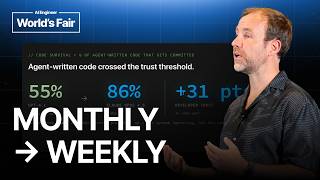
Track code survival metrics to see the percentage of agent-written code that actually gets committed. GPT-4.1 started at 55%, while Claude Opus reached 86% over time. This increase clearly demonstrates growing developer trust and confidence in AI code generation.
While virtual machines simulate an entire hardware stack and run their own operating system, containers only virtualize the OS. This means containers share a single operating system kernel, making them significantly faster and more efficient.
How do Flocks environments differ from traditional containers for AI workloads?
Unlike containers that add an abstraction layer and require poking holes for hardware access, Flocks runs fully locally on the system. This allows direct, native access to local GPUs and hardware without losing file path isolation.
Create living documentation like agents.mmd files that give agents lightweight maps of the codebase. These documents should evolve as agents make mistakes and help guide them effectively.
The Docker universe relies on three fundamental elements: the Dockerfile, the immutable image, and the running container. The Dockerfile acts as code instructing Docker how to build the image snapshot, which can then be spun up into running containers.
What makes Nix different from traditional package managers?
Nix enforces a concept called purity, which requires every package to come completely self-contained with all of its recursive dependencies all the way down to the kernel. This provides a unified way to handle libraries, dependencies, and environments identically.
How can expert knowledge be distributed to developers and agents?
Encode expert knowledge into skills that anyone or any agent can use, such as accessibility best practices. This unblocks teams by scaling insights that were previously locked with single experts.
How do I build and run a container from a Dockerfile?
You define your build steps starting from a base image using the FROM instruction, install dependencies with RUN, and set a default startup command. Then you use the docker build command to create the image layer by layer, and bring it to life using docker run.
Why is deterministic infrastructure critical for agent-generated code handoffs?
Deterministic infrastructure ensures that the underlying stack remains completely reproducible and free of environment conflicts during handoffs. By establishing a solid baseline, teams and agents can easily test, validate, and run code without running into environment mismatch issues.
What build system change is necessary when scaling up AI agents?
Switch to TypeScript Go to prevent CI/CD bottlenecks from compounding when running multiple agents concurrently. This upgrade provided a tenfold improvement in build speeds, which is crucial for fast feedback loops.
Why do AI agents need specialized development environments?
Agents require execution environments to test generated code, check for exceptions, and get immediate feedback. Tools like Nix and Flox provide lean, fast, and portable setups that align well with agent validation workflows.
How do you automate UI validation for agent changes?
Use an automated component browser that takes screenshots of every component on every change to point out visual differences. This allows developers to quickly detect unexpected side effects and review pull requests efficiently.
What are the three domains of environment management in AI?
Environment management in AI manifests in runtime execution, generating environments for vibe coding applications, and picking environments for tool use. These domains help transition from disposable minute apps to long-term viable software.
Leverage Playwright through a launch skill to automatically open the application and click through specific test scenarios. This provides a self-correcting loop where agents can diagnose and validate fixes without manual intervention.
What is the sous-chef reliability threshold for AI agents?
The reliability threshold describes how developers want AI to act like a consistent assistant that reliably performs routine tasks without erratic errors. Currently, advanced models still fail occasionally on basic tasks, preventing developers from fully trusting them to work autonomously.
How do you handle the surge in bug reports caused by AI?
Implement automated AI filtering to remove spam, translate text, and assign issues to proper area owners to improve signal-to-noise ratios. A human-in-the-loop Chrome extension layer is also used to fix duplicate issues and feed data back into the system.
Should students still study computer science and software engineering today?
Studying computer science remains highly valuable because fundamental principles never change despite new abstractions and languages. Understanding deep fundamentals allows developers to be much more effective regardless of the abstraction layer.
How are error stacks automatically addressed with pull requests?
Raw telemetry filters down error stacks, groups them via fingerprinting, and assigns them to area owners with an auto-created PR. An agent investigates the root cause, finds symbols, and opens a fix that can be merged quickly.
Why are staged rollouts important when increasing release velocity?
Instead of doing zero-day full releases to 100% of users, staged rollouts help derisk the release process. Teams monitor error logs and issues incrementally because rollbacks on installed desktop applications are very expensive.
How do you maintain evaluations for an agentic product?
Use an internal benchmark harness where new scenarios are easily bootstrapped via templates from GitHub issues. This allows teams to hill-climb against offline evals and conduct online experimentation for rapid product growth.
 ▶ 0:50
One CEO’s Plan to Rebuild How We Deploy AI | Ron Efroni & Flox